Sodium-lowering
Hyponatremia (sodium-lowering effect)
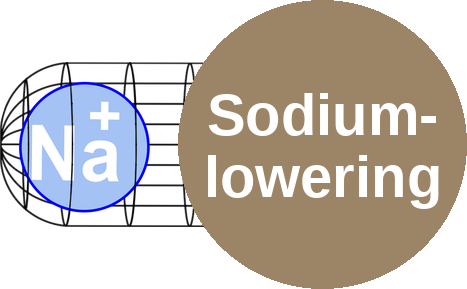
- ↓ serum Na⁺ → nausea, confusion, falls
- Seizures and coma if severe or fast
- SIADH-like: ↑ ADH release or renal ADH sensitivity (carbamazepine family, cyclophosphamide, vincristine; SRIs mildly)
- Direct V2 agonism (desmopressin, oxytocin at high infusion rates)
- Renal salt wasting (thiazides, cisplatin)
- Correct slowly: ≤ 8–10 mmol/L per 24 h to avoid osmotic demyelination
What hyponatremia is and why it matters
Sodium below 135 mmol/L — a water problem more often than a salt problem
- Serum Na⁺ < 135 mmol/L; severe below about 120, or any level with neurological symptoms [1][2]
- Most drug-induced cases are dilutional: the body holds water it should have excreted, and the sodium is diluted, not lost [3]
- Chronic and mild: nausea, unsteady gait, falls, inattention, fractures — easy to miss in an older patient [1]
- Acute or severe: brain swelling → headache, vomiting, seizures, coma, death; the brain has had no time to adapt [1][2]
- The paradox of treatment: raising sodium too fast after the brain has adapted causes osmotic demyelination (the pons first) [1][2]
How the body holds sodium steady
ADH, thirst and the kidney — and where drugs break in
- Antidiuretic hormone (vasopressin) from the posterior pituitary acts on renal V2 receptors → aquaporin-2 → water is reabsorbed, urine concentrates
- A falling plasma osmolality should switch ADH off and let dilute urine carry the excess water away
- SIADH: ADH keeps acting when it should not — concentrated urine despite low plasma osmolality, normal volume, normal adrenal and thyroid function [1][2]
- Four ways a drug lowers sodium: mimic or release ADH (SIADH-like), stimulate V2 directly, waste salt through the kidney, or drive water in faster than the kidney can excrete it [3]
Route 1 — SIADH-like: the carbamazepine family
The antiseizure drugs with the biggest sodium effect
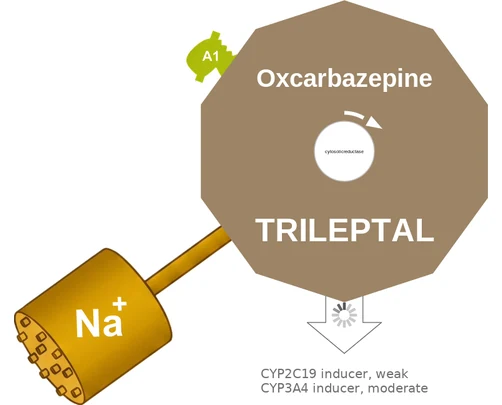
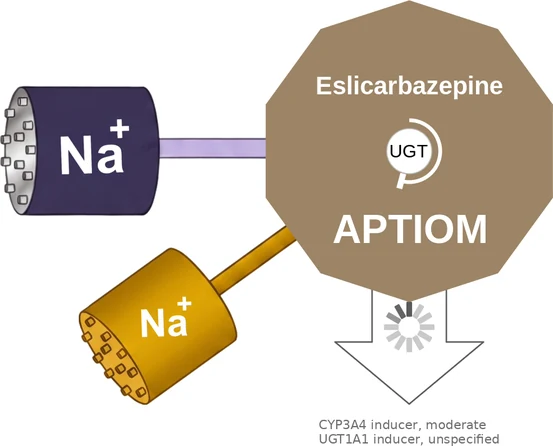
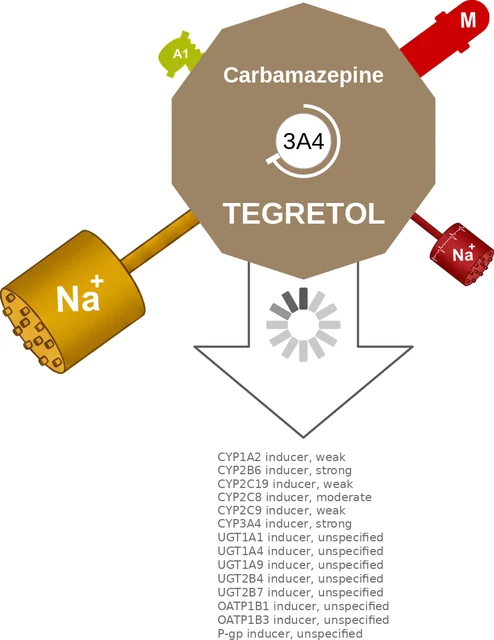
- Carbamazepine, oxcarbazepine and eslicarbazepine increase the renal response to ADH and probably ADH release; the effect is dose-related [3][4]
- Oxcarbazepine is the worst of the three: sodium < 125 mmol/L in 2.5% of patients in its controlled trials, and any hyponatremia in about half of long-term users in a large epilepsy cohort [4][5]
- Carbamazepine: about a quarter of long-term users in the same cohort, severe in a minority [4]
- Eslicarbazepine: a dose-related label warning; less than oxcarbazepine at comparable doses — the same active molecule, less of it as the R-enantiomer and a flatter curve [6]
- Risk multiplies with age, thiazides, other sodium-lowering drugs and high doses; check sodium before and within the first weeks [4][5]
Route 1 — SIADH-like: the serotonergic and other drugs
Why the SRIs are not pegged
- SSRIs and SNRIs raise ADH release; reported incidence varies enormously with the definition used, and the risk sits in older patients, in the first weeks, and with concurrent diuretics [3][7]
- The effect is mild and common to the whole class — it comes with SERT binding — so it is described on the SERT card rather than pegged on every SRI ballicule
- Mirtazapine, bupropion and agomelatine carry less risk than the SRIs [7]
- Cyclophosphamide (high-dose IV) and vincristine cause SIADH; the forced hydration given with cyclophosphamide compounds it [3][12]
- Ifosfamide: SIADH and proximal tubular injury [12]
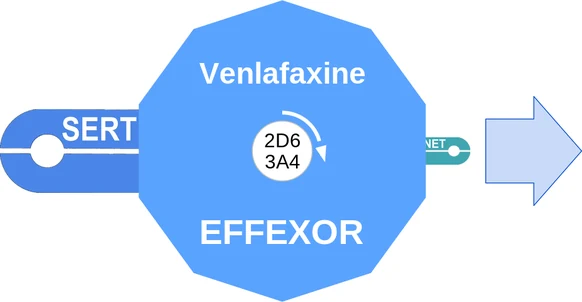
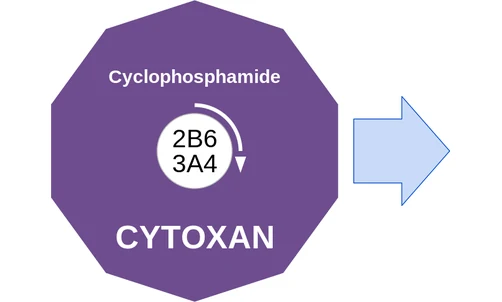
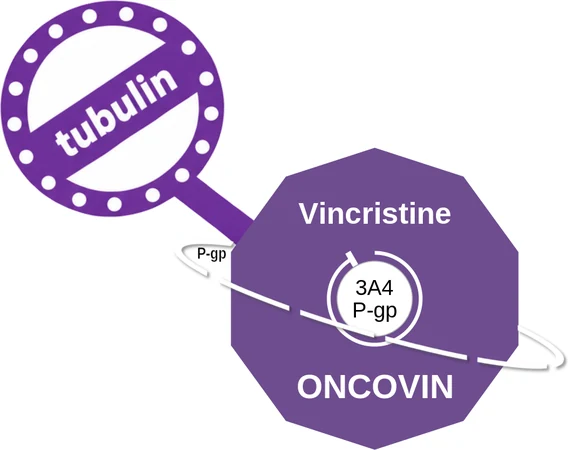
Route 2 — direct V2 agonism
The drug is the antidiuretic hormone
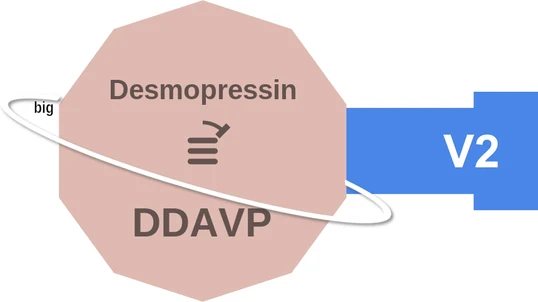
- Desmopressin is a V2-selective vasopressin analog: every dose is a dose of antidiuresis, and water taken on top of it has nowhere to go [9]
- The nocturia products carry a boxed warning for hyponatremia; sodium is checked before starting and within the first week [9]
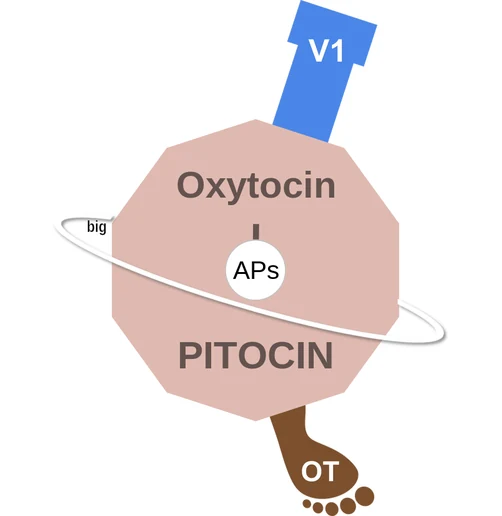
- Oxytocin shares enough structure to act on V2 at high infusion rates — water intoxication with prolonged infusion, worse with hypotonic fluids [10]
Route 3 — renal salt wasting: the thiazides
The commonest drug cause of hyponatremia
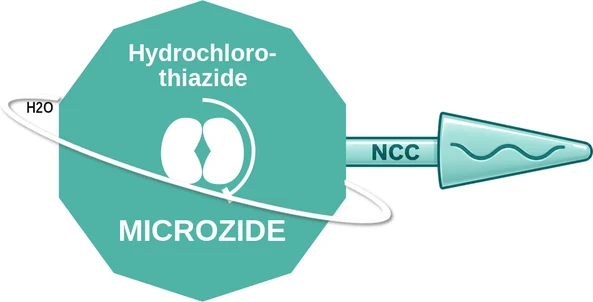
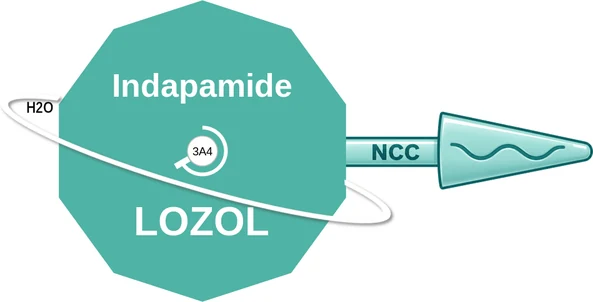
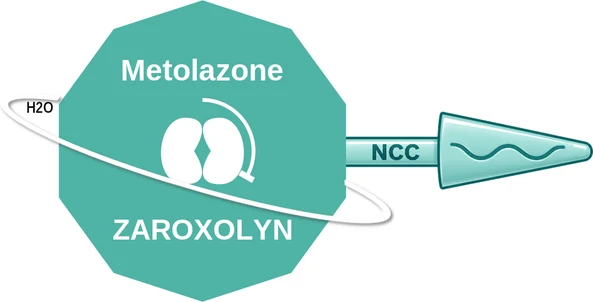
- Thiazides block the distal NCC cotransporter: sodium is lost while the kidney keeps its ability to concentrate urine, so water is retained on top of the salt loss [3][8]
- Loop diuretics rarely do this — they wash out the medullary gradient, so the kidney cannot hold water either [3]
- Onset is usually within the first weeks; older women, low body weight and higher doses carry the risk; it recurs on rechallenge [8]
- Chlorthalidone and indapamide are longer-acting than hydrochlorothiazide and are implicated at least as often [8]
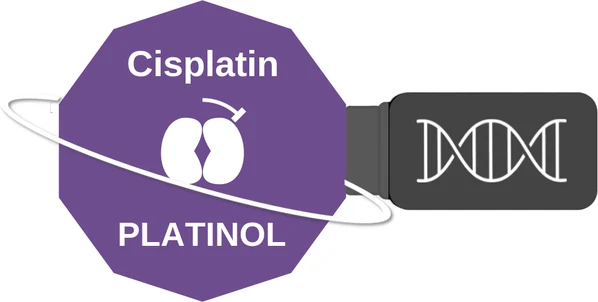
- Cisplatin: renal salt wasting from tubular injury, plus SIADH — a different route to the same number [12]
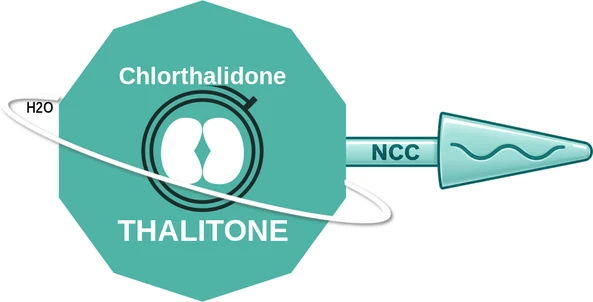
Route 4 — water in faster than it can leave
MDMA and polydipsia
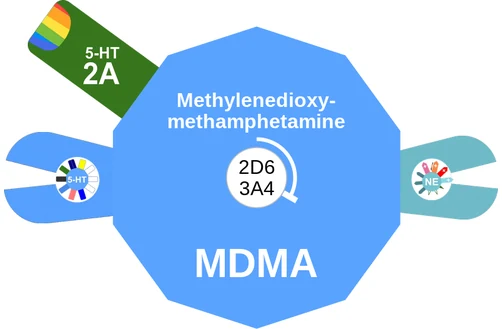
- MDMA releases ADH and drives thirst at the same time; dancing, heat and deliberate water-loading finish the job — the classic fatal hyponatremia of a young woman at a party [11]
- Psychogenic polydipsia in schizophrenia: intake outruns even a normal kidney; antipsychotics are the context, not the cause
- Beer potomania and "tea and toast": too little solute to excrete free water — a diet problem that drugs can unmask
Who is at risk, and what to check
The same patient keeps appearing
- Older age, female sex, low body weight, and any second sodium-lowering drug — the thiazide plus SSRI plus oxcarbazepine combination is the one to notice [3][8]
- Check sodium before starting and within the first two to four weeks for thiazides, oxcarbazepine or eslicarbazepine, desmopressin, and SRIs in the elderly [5][8][9]
- Symptoms are non-specific: a confused, unsteady older patient on a new drug has hyponatremia until proven otherwise
Treatment — and the speed limit
Stop the drug, restrict water, and go slowly
- Mild and chronic: stop or reduce the drug; restrict fluid; add solute (salt tablets, urea) if needed [1][2]
- Severe symptoms (seizure, coma): hypertonic 3% saline in small boluses until symptoms settle, then stop [1][2]
- Limit the rise to about 8–10 mmol/L in the first 24 hours; slower still when the risk of osmotic demyelination is high (sodium ≤ 105, hypokalemia, alcoholism, malnutrition, liver disease) [1][2]
- Vaptans (V2 antagonists) treat SIADH by making the kidney excrete water — never for hypovolemic hyponatremia, and never with fluid restriction in the first day [1][2]
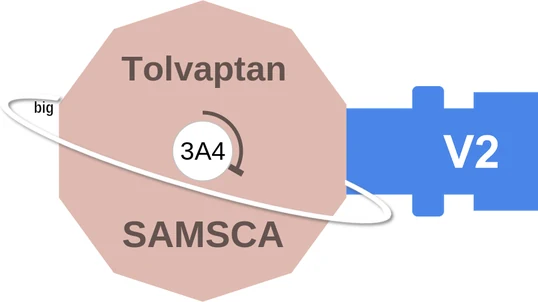
How the peg is sized
Editorial magnitude, not a measurement
- Full size: chlorthalidone and desmopressin — a boxed warning or the commonest cause
- Large: the other thiazides and oxcarbazepine
- Middle: cyclophosphamide, MDMA, carbamazepine, eslicarbazepine, oxytocin, ifosfamide, vincristine, cisplatin
- Not pegged: SRIs, TCAs, mirtazapine, antipsychotics, NSAIDs, opioids, loop and potassium-sparing diuretics, lamotrigine, valproate, levetiracetam, ACE inhibitors — at or below the SRI level
References
Numbered as cited on the slides
- [1] Verbalis JG, et al. Diagnosis, evaluation, and treatment of hyponatremia: expert panel recommendations. Am J Med 2013;126(10 Suppl 1):S1–S42
- [2] Spasovski G, et al. Clinical practice guideline on diagnosis and treatment of hyponatraemia. Eur J Endocrinol 2014;170:G1–G47
- [3] Liamis G, Milionis H, Elisaf M. A review of drug-induced hyponatremia. Am J Kidney Dis 2008;52:144–153
- [4] Berghuis B, et al. Carbamazepine- and oxcarbazepine-induced hyponatremia in people with epilepsy. Epilepsia 2017;58:1227–1233
- [5] Oxcarbazepine (TRILEPTAL) prescribing information: clinically significant hyponatremia (sodium <125 mmol/L) in 2.5% of treated patients in controlled trials
- [6] Eslicarbazepine acetate (APTIOM) prescribing information: dose-related hyponatremia; warnings and precautions
- [7] De Picker L, et al. Antidepressants and the risk of hyponatremia: a class-by-class review of literature. Psychosomatics 2014;55:536–547
- [8] Barber J, et al. A systematic review and meta-analysis of thiazide-induced hyponatraemia: time to reconsider electrolyte monitoring regimens after thiazide initiation? Br J Clin Pharmacol 2015;79:566–577
- [9] Desmopressin nasal spray for nocturia (NOCTIVA) prescribing information: boxed warning for hyponatremia
- [10] Oxytocin (PITOCIN) prescribing information: water intoxication with prolonged infusion and hypotonic fluids
- [11] Hall AP, Henry JA. Acute toxic effects of "Ecstasy" (MDMA) and related compounds: overview of pathophysiology and clinical management. Br J Anaesth 2006;96:678–685
- [12] Cyclophosphamide, vincristine, cisplatin and ifosfamide prescribing information: hyponatremia / SIADH / renal salt wasting in warnings and adverse reactions
Drugs with this mechanism (19)
- Carbamazepine — Anticonvulsant/mood stabilizer and potent autoinducer; HLA-B*1502 rash risk.
- Carbamazepine ER capsules — Bead-filled extended-release carbamazepine capsule that can be opened and sprinkled.
- Chlorothiazide — The original thiazide diuretic; the only one available in an intravenous form.
- Chlorthalidone — Long-acting thiazide-like diuretic; preferred for hypertension outcomes.
- Cisplatin — Platinum DNA-crosslinking chemotherapy; nephro-, oto-, and neurotoxic.
- Cyclophosphamide — DNA-alkylating chemotherapy and immunosuppressant; hemorrhagic cystitis.
- Desmopressin — Vasopressin V2 analog for diabetes insipidus, enuresis, and bleeding.
- Carbamazepine ER (Equetro) — Carbamazepine ER capsule - the only carbamazepine approved for acute bipolar mania.
- Eslicarbazepine — Once-daily sodium-channel anticonvulsant related to oxcarbazepine.
- Hydrochloro thiazide — The most-prescribed thiazide diuretic for hypertension.
- Ifosfamide — Alkylating chemotherapy; neurotoxic, needs mesna for cystitis.
- Indapamide — Thiazide-like diuretic antihypertensive.
- Methylenedioxy methamphetamine — Serotonin releaser (empathogen) under study for PTSD.
- Metolazone — Thiazide-like diuretic that works even in renal impairment; adds to loop diuretics.
- Oxcarbazepine — Prodrug of licarbazepine; carbamazepine analog with less enzyme induction and more hyponatremia.
- Oxcarbazepine XR — Extended-release oxcarbazepine for focal seizures; hyponatremia and enzyme induction complicate use.
- Oxytocin — Uterotonic hormone used to induce labor and control postpartum hemorrhage.
- Carbamazepine XR — Extended-release carbamazepine for seizures and trigeminal neuralgia; potent enzyme inducer.
- Vincristine — Vinca-alkaloid chemotherapy; dose-limiting peripheral neuropathy, fatal if intrathecal.
All mechanisms · Open Sodium-lowering in the interactive console ↗