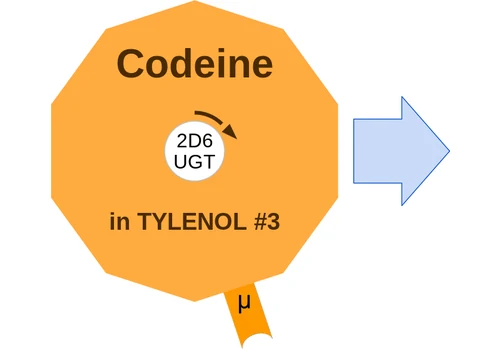
Codeine
in TYLENOL #3
What it isWeak opioid requiring CYP2D6 conversion to morphine; mild to moderate pain and cough.
Why this oneIt is one of few opioids used as both an analgesic and antitussive, but offers little advantage over direct-acting alternatives.
What limits itCYP2D6 variation makes it inactive or toxic; avoid after pediatric tonsil or adenoid surgery and during breastfeeding.
FDA-approved for
- pain (~1950)
- cough (~1950)
FDA label
Read the full label on DailyMed ↗
| FDA dosing | Population | Start | Target | Max |
|---|---|---|---|---|
| Mild-to-moderate pain | Adult | 300-600 mg acetaminophen / 30-60 mg codeine q4h PRN | 1-2 tablets q4h PRN (15/300 or 30/300); 1 tablet q4h PRN (60/300) | Codeine 360 mg/day; acetaminophen 4,000 mg/day |
Renal Undefined
Hepatic Undefined
Maximum codeine 360 mg and acetaminophen 4,000 mg per 24 hours
Instructions
- Use the lowest effective dose for the shortest duration
- Do not abruptly discontinue in physically dependent patients; taper (e.g., by 10-25% of daily dose every 2-4 weeks)
- Do not exceed 4,000 mg/day acetaminophen; avoid other acetaminophen-containing products
- Advise access to an opioid overdose reversal agent (naloxone/nalmefene)
Contraindications
- Children younger than 12 years
- Postoperative management in children <18 yr after tonsillectomy and/or adenoidectomy
- Significant respiratory depression
- Acute or severe bronchial asthma in an unmonitored setting or without resuscitative equipment
- MAOIs (concurrently or within 14 days)
- Known or suspected gastrointestinal obstruction, including paralytic ileus
Cautions
- Life-threatening respiratory depression
- Ultra-rapid CYP2D6 metabolizers (esp. children)
- Neonatal opioid withdrawal syndrome
- Interactions with CNS depressants
- Opioid-induced hyperalgesia and allodynia
- Severe hypotension
- Gastrointestinal adverse reactions
- Seizures
- Adrenal insufficiency
- Serotonin syndrome with concomitant serotonergic drugs
- Acetaminophen hepatotoxicity
- Withdrawal on abrupt discontinuation
Adverse reactions
- Drowsiness/sedation
- Lightheadedness; dizziness
- Nausea; vomiting
- Constipation
- Sweating
- Shortness of breath
- Hypotension; palpitations
- Pruritus; rash
Pregnancy Prolonged use can cause neonatal opioid withdrawal syndrome; use only if potential benefit justifies potential fetal risk
Lactation Undefined
⚠ BOXED WARNINGS
- Addiction, abuse and misuse
- Life-threatening respiratory depression
- Ultra-rapid metabolism and death in children
- Risk from concomitant use with benzodiazepines
Cost, est. cash$10–$300/month
Generic entry2014
Classes and tags
Clinical profile
Legacy pregnancy categoryC
Defining liabilityRespiratory depression, dependence and overdose; risk rises sharply with sedatives or impaired clearance.
Active metabolites
Mechanism of action: Codeine ballicule
Open Codeine in the interactive console ↗
Memory aids: mascots and interaction avatars

metabolized to morphine
rabbit is the morphine mascot
“purple drank” is a concoction containing morphine cough syrup