Elimination kinetics
Pharmacokinetic topic
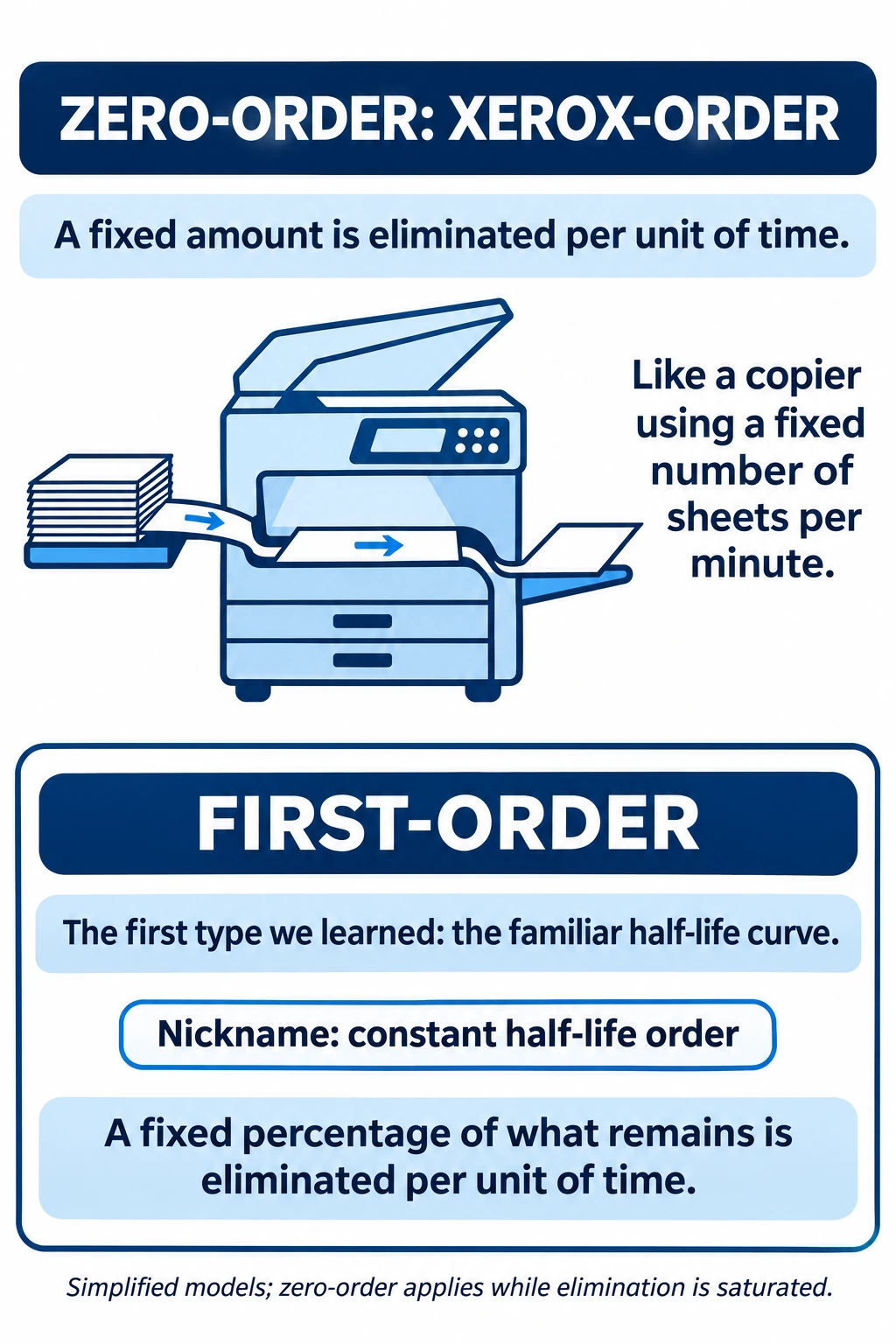
Elimination is described by its ORDER: what a constant interval removes. First-order removes a constant FRACTION of what is there, which is the familiar half-life curve. Zero-order removes a constant AMOUNT, because the clearing enzyme is already working flat out and cannot go faster.
Almost every drug in this library is first-order at the doses people take. The handful below are the exceptions worth knowing, and they are exceptions for one reason: the enzyme that clears them saturates at concentrations patients actually reach. Saturable does not mean zero-order everywhere — it means kinetics BECOME zero-order as the pathway fills, which is why the warning attaches to the top of the range and to overdose rather than to the starting dose.
The two orders
- First-order: a fixed PERCENTAGE of what remains leaves per unit time. Half-life is constant, so it is a usable number, and the drug accumulates to steady state in about five of them.
- Zero-order: a fixed AMOUNT leaves per unit time, whatever the level. Half-life is not constant and not usable — the time to fall by half gets longer as the level climbs.
- The mnemonic is XEROX-order: a copier prints a fixed number of sheets a minute no matter how tall the stack.
- Why it happens: clearance depends on an enzyme, and an enzyme has a maximum rate. Below saturation the rate rises with concentration (first-order); at saturation it flattens (zero-order).
Why it matters at the bedside
- Under first-order kinetics, doubling the dose roughly doubles the level. Under saturation it does not — the level can rise several-fold, which is how a reasonable-looking dose increase causes toxicity.
- Half-life stops predicting anything: it lengthens as the concentration rises, so both time-to-steady-state and time-to-clear stretch out.
- The practical rules follow directly: increase in small increments near the top of the range, measure levels rather than inferring them, and expect a long tail after an overdose.
Phenytoin, the cleanest example
- The Dilantin label states that phenytoin "is hydroxylated in the liver by an enzyme system which is saturable at high serum levels", so "small incremental doses may increase the half-life and produce very substantial increases in serum levels".
- It puts a number on it: the steady-state level "may be disproportionately increased, with resultant intoxication, from an increase in dosage of 10% or more".
- The quoted half-life — an average of 22 hours, range 7 to 42 — is therefore a figure for the lower part of the range, not a constant.
- Fosphenytoin is a phenytoin prodrug, so the same ceiling applies to what it delivers.
The rest of the library
- Theophylline and aminophylline: the label calls both biotransformation pathways "capacity-limited", and says non-linearity "may begin in some patients at serum theophylline concentrations < 10 mcg/mL" — below the usual therapeutic range, not above it.
- Voriconazole: "The pharmacokinetics of voriconazole are non-linear due to saturation of its metabolism", with "greater than proportional increase in exposure"; raising the oral dose from 200 mg to 300 mg twice daily raises AUC about 2.5-fold.
- Aspirin, salicylate and bismuth subsalicylate: the aspirin labeling states that "salicylate metabolism is saturable" and that elimination of salicylic acid "follows zero order pharmacokinetics"; after toxic doses the half-life may exceed 20 hours against about 6 hours otherwise.
- Fomepizole: "saturable elimination occurring at therapeutic blood concentrations" — but it induces its own metabolism within 30 to 40 hours and then reverts to first-order, so it is a poorer teaching case than phenytoin.
- Ethanol: the textbook archetype, cleared at a roughly fixed amount per hour because alcohol dehydrogenase saturates at concentrations well below intoxication. It carries no FDA label to quote.
Self-check
- A patient on phenytoin has a level at the top of the range. You raise the dose 10 percent. What should you expect?
A disproportionate rise, not a 10 percent rise — the label warns of intoxication from exactly that increment. - Why is half-life a poor description of a saturated drug?
Half-life assumes a constant fraction leaves per unit time. Under saturation a constant amount leaves, so the time to fall by half lengthens as the level rises.
Medications in this library whose elimination saturates (10)
Open these medications on the dashboard ↗
Open Elimination kinetics in slides ↗