Fosphenytoin
CEREBYX
What it isWater-soluble IV or IM prodrug of phenytoin; status epilepticus loading and short-term parenteral substitution.
Why this oneIt can be infused faster and causes less local tissue injury than IV phenytoin; IM administration is possible.
What limits itRapid IV infusion can cause severe hypotension and fatal arrhythmia—monitor ECG and blood pressure. Prescribe in phenytoin-equivalent units.
FDA-approved for
- seizures (IV/IM) (1996)
FDA label
Read the full label on DailyMed ↗
| FDA dosing | Population | Start | Target | Max |
|---|---|---|---|---|
| Status epilepticus | Adult | 15-20 mg PE/kg IV loading at 100-150 mg PE/min | maintenance 4-6 mg PE/kg/day divided | per level |
| Status epilepticus | Pediatric | 15-20 mg PE/kg IV loading at 2 mg PE/kg/min (or 150 mg PE/min, whichever slower) | per level | per level |
| Non-emergent loading and maintenance | Adult | 10-20 mg PE/kg IV or IM loading | 4-6 mg PE/kg/day divided | per level |
| Non-emergent loading and maintenance | Pediatric | 10-15 mg PE/kg loading at 1-2 mg PE/kg/min (or 150 mg PE/min, whichever slower) | 2-4 mg PE/kg q12h at 1-2 mg PE/kg/min | per level |
Renal Monitor unbound phenytoin concentrations in renal disease or hypoalbuminemia
Hepatic Monitor unbound phenytoin concentrations in hepatic disease or hypoalbuminemia
Concentration is 50 mg PE/mL; a 10 mL vial contains 500 mg PE total.
Instructions
- Always dose, concentrate, and infuse in phenytoin sodium equivalents (PE); no molecular-weight conversion needed
- Do not confuse vial concentration (50 mg PE/mL) with total vial content
- Should ordinarily not be given intramuscularly for status epilepticus
- Discontinue gradually to avoid precipitating status epilepticus
Contraindications
- Sinus bradycardia, sino-atrial block, second/third-degree AV block, or Adams-Stokes syndrome
- History of prior acute hepatotoxicity attributable to fosphenytoin or phenytoin
- Coadministration with delavirdine
Cautions
- Dosing errors (PE vs concentration)
- Withdrawal-precipitated seizure/status epilepticus
- Serious dermatologic reactions (SJS/TEN)
- DRESS/multiorgan hypersensitivity
- Hypersensitivity (cross-sensitivity with hydantoins)
- Angioedema
- Hepatic injury
- Hematopoietic complications
- Cardiac effects with rapid infusion
- Suicidal behavior/ideation
Adverse reactions
- Nystagmus
- Dizziness
- Pruritus
- Paresthesia
- Headache
- Somnolence
- Ataxia
Pregnancy Prenatal phenytoin (active metabolite) exposure may increase risk of congenital malformations and adverse developmental outcomes.
Lactation Undefined
⚠ BOXED WARNING
- Rapid IV infusion can cause severe hypotension and fatal cardiac arrhythmias; do not exceed the recommended rate and monitor cardiac rhythm and blood pressure during and after infusion
Cost, est. cash$20–$1,500/dose or month
Generic entry2007
Classes and tags
Clinical profile
Legacy pregnancy categoryD
Defining liabilityCardiovascular collapse with rapid administration and phenytoin-related nonlinear toxicity.
Active metabolites
Mechanism of action: Fosphenytoin ballicule
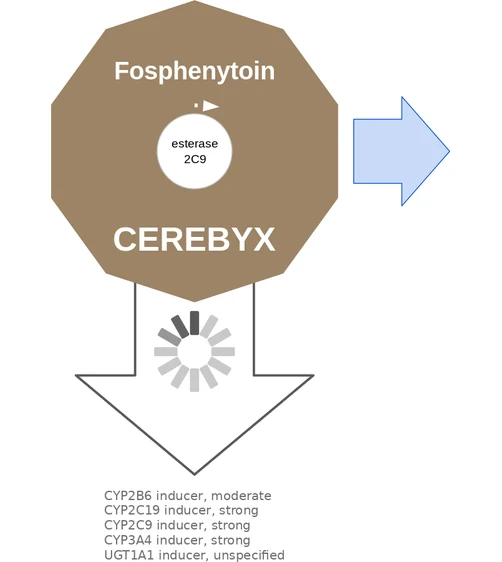
Open Fosphenytoin in the interactive console ↗
Memory aids: mascots and interaction avatars

Variation of phenytoin mascot
Water-soluble phenytoin prodrug for IV/IM loading