Peripheral Nav blocker
Peripheral voltage-gated sodium channel blocker
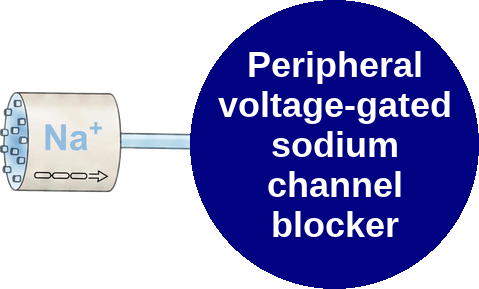
- Conduction failure → local anesthesia
- Systemic absorption risks CNS and cardiac toxicity
- suzetrigine (JOURNAVX)
Drugs with this mechanism (10)
- Articaine — Amide dental local anesthetic with fast onset.
- Bupivacaine — Long-acting local anesthetic; cardiotoxic if given intravascularly.
- Cocaine — Monoamine-reuptake-inhibiting local anesthetic; vasoconstriction preserves its ENT niche.
- Lidocaine topical — Topical amide local anesthetic — patch, jelly, ointment; the patch treats localized neuropathic pain.
- Lidocaine injection — Injectable sodium-channel blocker for local anesthesia and ventricular arrhythmias.
- Mepivacaine — Amide local anesthetic with little vasodilation; useful without epinephrine.
- Prilocaine — Amide local anesthetic; methemoglobinemia at high dose.
- Procaine — The original ester local anesthetic (Novocaine); short-acting.
- Ropivacaine — Long-acting local anesthetic; less cardiotoxic than bupivacaine.
- Tetracaine — Potent, long-acting ester local anesthetic (topical/spinal).
Self-check
- How does peripheral sodium-channel blockade produce local anesthesia?
Conduction failure. - What toxicity can follow systemic absorption of peripheral sodium blockers?
CNS and cardiac toxicity.
All mechanisms · Open NaV blocker (peripheral) in the interactive console ↗