Lidocaine injection
XYLOCAINE
What it isPeripheral and cardiac sodium-channel blocker; local or regional anesthesia and acute ventricular arrhythmias.
Why this oneIt uniquely combines local anesthetic use with intravenous class Ib antiarrhythmic action.
What limits itIntravascular injection or excess exposure causes tinnitus, circumoral numbness, seizures, then cardiovascular collapse.
FDA label
Read the full label on DailyMed ↗
| FDA dosing | Population | Start | Target | Max |
|---|---|---|---|---|
| Local or regional anesthesia (infiltration, peripheral nerve block, epidural) | Adults | Individualized by procedure/site (e.g., ~2–3 mL per dermatome for epidural); use lowest effective dose |
Renal Undefined.
Hepatic Use with caution in hepatic disease; severe hepatic disease increases risk of toxic plasma concentrations.
Instructions
- Reduce doses for children, elderly/debilitated patients, and those with cardiac or liver disease
- Use a test dose (e.g., 2–3 mL of 1.5%) for epidural blocks
- Aspirate before and during injection; have resuscitative equipment available
Contraindications
- Hypersensitivity to amide-type local anesthetics
Cautions
- Dose-related CNS and cardiovascular toxicity
- Methemoglobinemia
- Caution in hepatic and impaired cardiovascular function
- Not for intra-articular continuous infusion (chondrolysis)
Adverse reactions
- CNS excitation/depression (lightheadedness, tremors, seizures)
- Bradycardia
- Hypotension
- Cardiovascular collapse
- Allergic/anaphylactoid reactions
Pregnancy Undefined.
Lactation Undefined.
NO BOXED WARNINGS
Classes and tags
Clinical profile
Mechanism of action: Lidocaine injection ballicule
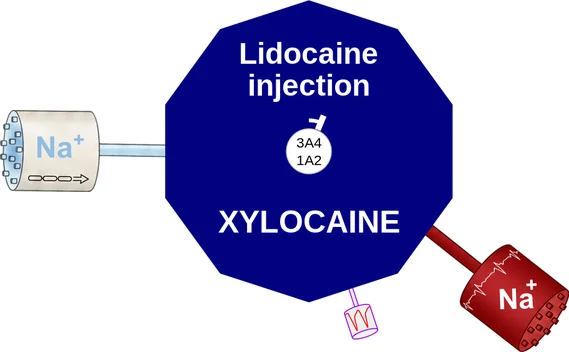
Open Lidocaine injection in the interactive console ↗
Memory aids: mascots and interaction avatars