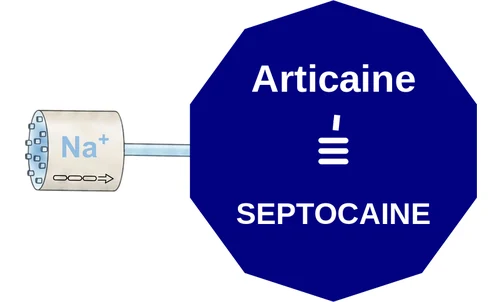
Articaine
SEPTOCAINE
What it isPeripheral sodium-channel blocker with amide and ester features; dental anesthesia.
Why this oneRapid onset and good bone penetration make it a dental workhorse, and plasma esterases clear it quickly.
What limits itParesthesia after mandibular block is reported more often with articaine than with lidocaine.
FDA-approved for
- dental anesthesia (2000)
FDA label
Read the full label on DailyMed ↗
| FDA dosing | Population | Start | Target | Max |
|---|---|---|---|---|
| Local/regional anesthesia for dental procedures (infiltration or nerve block) | adults | Infiltration 0.5-2.5 mL (20-100 mg); nerve block 0.5-3.4 mL (20-136 mg); oral surgery 1-5.1 mL (40-204 mg) | lowest effective dose | 7 mg/kg (0.175 mL/kg) |
| Local/regional dental anesthesia | peds 4-16 y | per procedure | lowest effective dose | 7 mg/kg (0.175 mL/kg) |
Renal Undefined
Hepatic Undefined
Maximum 7 mg/kg articaine HCl (healthy adults and children 4-16 y).
Instructions
- Intraoral submucosal infiltration or nerve block only.
- Aspirate before injecting to avoid intravascular injection; reposition needle until no blood returns.
- Use the lowest dose that produces the desired effect.
- 1:200,000 epinephrine preferred for routine procedures; 1:100,000 when more hemostasis/visualization is needed.
Contraindications
- Hypersensitivity to sulfites
Cautions
- Accidental intravascular injection — convulsions, coma, respiratory arrest
- Systemic toxicity affecting CNS and cardiovascular systems
- Vasoconstrictor toxicity — caution in impaired cardiovascular function or vascular disease
- Methemoglobinemia
Adverse reactions
- Headache
- Pain
- Face edema
- Paresthesia
- Gingivitis
Pregnancy Pregnancy Category C; no adequate studies; use only if benefit justifies risk (animal fetal death/skeletal variations).
Lactation Exercise caution when administering to a nursing woman.
NO BOXED WARNINGS
Principal riskParaesthesia after mandibular block is reported more with articaine than with lidocaine
Classes and tags
Clinical profile
Mechanism of action: Articaine ballicule