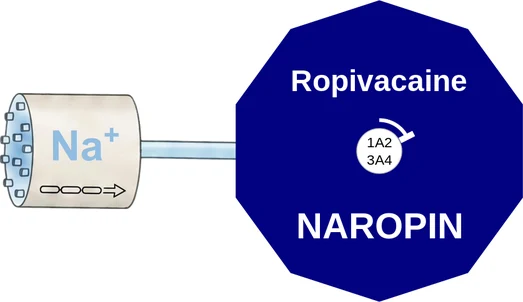
Ropivacaine
NAROPIN
What it isLong-acting amide local anesthetic that blocks voltage-gated sodium channels; used for epidural, peripheral nerve, and local infiltration anesthesia.
Why this oneProvides prolonged sensory block with less motor block and less cardiotoxicity than comparable bupivacaine concentrations.
What limits itIntravascular injection or excessive dose causes local-anesthetic systemic toxicity; inject incrementally with aspiration and cardiorespiratory monitoring.
FDA-approved for
- local/regional anesthesia (1996)
FDA label
Read the full label on DailyMed ↗
| FDA dosing | Population | Start | Target | Max |
|---|---|---|---|---|
| Surgical anesthesia (epidural, major nerve block, field block) | Adults | 0.5–1% (5–10 mg/mL) per block | — | Per block; e.g. epidural up to ~200 mg |
| Labor analgesia / acute postoperative pain (epidural infusion) | Adults | 0.2% (2 mg/mL) | — | Continuous epidural up to 28 mg/hr |
Renal Undefined
Hepatic Undefined
Dose varies by block type, site, and patient status; consult the block-specific dosage table.
Instructions
- Use the smallest effective dose and concentration; use fractional/incremental dosing
- Give an epinephrine-containing test dose before inducing complete block
- Single-dose, preservative-free; discard unused solution
- Not approved for intra-articular infusion (risk of chondrolysis)
Cautions
- CNS and cardiovascular toxicity from excessive plasma levels or inadvertent intravascular injection (arrhythmia, cardiac arrest)
- Chondrolysis with intra-articular infusion
- Methemoglobinemia
- Caution in debilitated, elderly, or hepatic/renal impairment
Adverse reactions
- Hypotension
- Nausea
- Vomiting
- Bradycardia
- Back pain
- Fever
- Headache
Pregnancy No human data; crosses the placenta and can cause fetal/neonatal toxicity when used in labor.
Lactation Present in human milk at low levels; no adverse reactions reported in breastfed infants.
NO BOXED WARNINGS
Principal risklocal-anesthetic systemic toxicity from inadvertent intravascular injection
Classes and tags
Clinical profile
Mechanism of action: Ropivacaine ballicule