Buprenorphine buccal film
BELBUCA
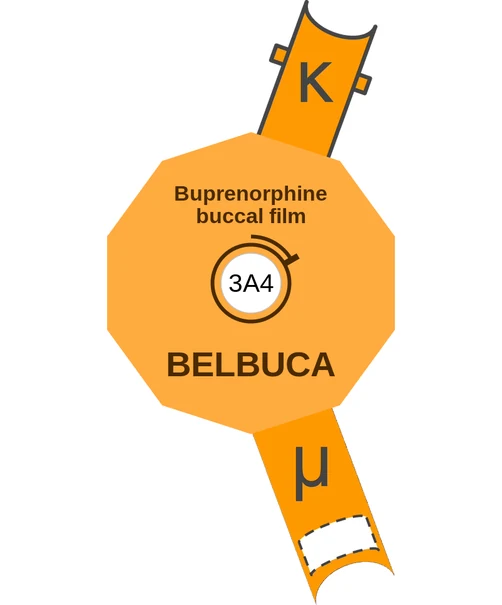
What it isPartial mu-opioid agonist and kappa antagonist in a buccal film (BELBUCA, 2015); around-the-clock chronic pain.
Why this onePain doses of 75-900 mcg BID are far below the OUD milligram range; t1/2 ~28 h.
What limits itRespiratory depression, dependence, and misuse persist; benzodiazepines and other depressants magnify the danger.
FDA-approved for
- chronic pain (around-the-clock) (2015)
FDA label
Read the full label on DailyMed ↗
| FDA dosing | Population | Start | Target | Max |
|---|---|---|---|---|
| Severe and persistent pain requiring an opioid analgesic (not prn) | Adults | Opioid-naïve: 75 mcg QD or q12h for ≥4 days, then 150 mcg q12h | Individually titrate in 150 mcg q12h increments | 900 mcg q12h |
Titration Increase no more frequently than every 4 days
Renal Undefined
Hepatic Severe (Child-Pugh C): reduce starting and titration/incremental dose by half
600, 750, and 900 mcg strengths only after titration from lower doses; do not exceed 900 mcg q12h (QTc)
Instructions
- Buccal film once daily or every 12 h; place yellow side against inside of cheek, hold 5 s, leave until dissolved
- Do not chew or swallow the film
- Convert from other opioids: taper to ≤30 mg oral morphine equivalents/day first, then base initial dose on prior opioid (Table 1)
- Do not abruptly discontinue in physically dependent patients — taper gradually
- Oral mucositis: reduce starting and incremental dose by half
Contraindications
- Significant respiratory depression
- Acute or severe bronchial asthma in an unmonitored setting or without resuscitative equipment
- Known or suspected gastrointestinal obstruction, including paralytic ileus
Cautions
- Opioid-induced hyperalgesia and allodynia
- Respiratory depression in chronic pulmonary disease or elderly/cachectic/debilitated patients
- Adrenal insufficiency
- Severe hypotension
- Increased intracranial pressure / head injury / impaired consciousness
- Hepatotoxicity
- GI complications (sphincter of Oddi spasm)
- Seizures in patients with seizure disorders
- Dental adverse events (caries, tooth loss)
- QTc prolongation
- Anaphylactic/allergic reactions
- Withdrawal on abrupt discontinuation
Adverse reactions
- Nausea
- Constipation
- Headache
- Vomiting
- Dizziness
- Somnolence
- Fatigue
Pregnancy Extended use during pregnancy can cause neonatal opioid withdrawal syndrome (may be life-threatening).
Lactation Buprenorphine present in human milk at low levels; breastfeeding not recommended (risk of sedation/respiratory depression).
⚠ BOXED WARNINGS
- Addiction, abuse and misuse
- Life-threatening respiratory depression
- Risk from concomitant use with benzodiazepines
Classes and tags
Clinical profile
Mechanism of action: Buprenorphine buccal film ballicule
Open Buprenorphine buccal film in the interactive console ↗
Memory aids: mascots and interaction avatars

pinpoint pupils → opioid
SubuTEXAS flag
SUBmarine periscope on bumper car