Buprenorphine
SUBUTEX
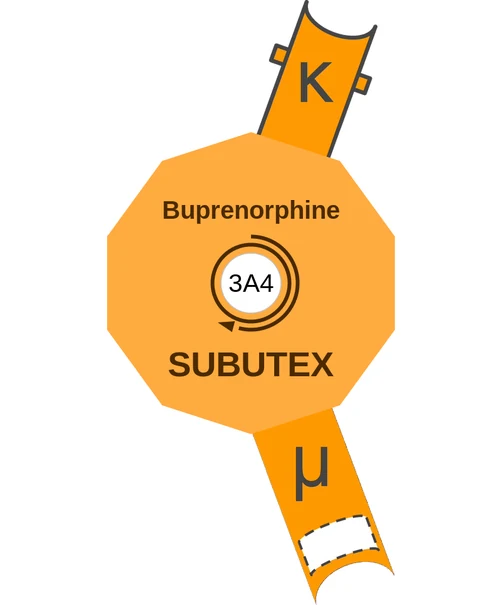
What it isPartial mu agonist with high receptor affinity; opioid use disorder and chronic pain.
Why this oneThe partial agonism gives a ceiling on respiratory depression, and the high affinity blocks other opioids, which is what makes it work in addiction.
What limits itThat same affinity precipitates withdrawal if given too early after a full agonist. Sublingual absorption; QT prolongation at higher doses.
FDA-approved for
- opioid use disorder (2002)
- pain (~1981)
Off-label
- treatment-resistant depression (limited evidence)
FDA label
Read the full label on DailyMed ↗
| FDA dosing | Population | Start | Target | Max |
|---|---|---|---|---|
| Opioid dependence — induction (mono product preferred for induction; buprenorphine/naloxone preferred for maintenance) | Adults | Day 1: up to 8 mg SL QD (in 2–4 mg increments); Day 2: 16 mg SL QD | 16 mg SL QD; maintenance range 4–24 mg QD | 24 mg QD (higher doses not studied in RCTs) |
Renal Undefined
Hepatic Severe impairment: consider halving starting and titration incremental doses; monitor for toxicity/overdose
NOT for use as an analgesic — deaths reported in opioid-naïve individuals given a 2 mg SL dose.
Instructions
- Administer sublingually as a single daily dose; tablets must be taken whole — do not cut, chew, or swallow.
- Place under the tongue until dissolved; no food or drink until fully dissolved; then sip water, swish gently, swallow; wait ≥1 hour before brushing teeth.
- Induct only when objective, clear signs of moderate opioid withdrawal are evident — ≥4 h after last short-acting opioid; generally ≥24 h after methadone/long-acting opioids.
- Adjust maintenance dose in 2 mg or 4 mg increments/decrements to suppress withdrawal and hold patient in treatment.
- Taper gradually when discontinuing to avoid withdrawal.
- Strongly consider prescribing an opioid overdose reversal agent (naloxone/nalmefene) at initiation and renewal.
Cautions
- Addiction, abuse, and misuse (Schedule III) — monitor for diversion; limit early refills.
- Life-threatening respiratory and CNS depression, especially with benzodiazepines, other CNS depressants, or alcohol.
- Unintentional pediatric exposure can be fatal — store out of sight and reach of children.
- Neonatal opioid withdrawal syndrome with prolonged use in pregnancy.
- Adrenal insufficiency — treat with physiologic corticosteroids and wean off opioid if diagnosed.
- Opioid withdrawal with abrupt discontinuation.
- Hepatitis/hepatic events — monitor LFTs before and during treatment.
- Precipitated opioid withdrawal if taken before agonist effects of other opioids have subsided (or with parenteral misuse).
- Overdose risk in opioid-naïve patients; orthostatic hypotension; elevated CSF and intracholedochal pressure; dental problems with sublingual route.
Adverse reactions
- Oral hypoesthesia, glossodynia, oral mucosal erythema
- Headache
- Nausea, vomiting
- Hyperhidrosis
- Constipation
- Withdrawal signs and symptoms, insomnia, pain, peripheral edema
Pregnancy Limited data do not indicate increased risk of major malformations; neonatal opioid withdrawal syndrome expected with prolonged use; dose adjustment (often higher) may be needed during pregnancy.
Lactation Present in low levels in human milk (<1% of maternal dose); no adverse reactions shown in breastfed infants — monitor infant for drowsiness and breathing difficulty.
⚠ BOXED WARNINGS
- Addiction, abuse and misuse
- Life-threatening respiratory depression
- Risk from concomitant use with benzodiazepines
Cost, est. cash$10–$300/month
Generic entry2018
Classes and tags
Clinical profile
Legacy pregnancy categoryC
Defining liabilityRespiratory depression and dependence remain possible, especially with benzodiazepines, alcohol or other sedatives.
Mechanism of action: Buprenorphine ballicule
Open Buprenorphine in the interactive console ↗
Memory aids: mascots and interaction avatars

pinpoint pupils → opioid
SubuTEXAS flag
SUBmarine periscope on bumper car