Rivaroxaban
XARELTO
What it isDirect factor Xa inhibitor; atrial fibrillation, venous thromboembolism and vascular protection.
Why this oneOnce-daily maintenance distinguishes it from apixaban, but its GI-bleeding profile is generally less favorable.
What limits itTreatment-strength tablets require food. Renal failure and strong dual CYP3A4/P-gp modulators can make exposure unsafe.
FDA-approved for
- VTE/stroke prevention (2011)
FDA label
Read the full label on DailyMed ↗
| FDA dosing | Population | Start | Target | Max |
|---|---|---|---|---|
| Reduce risk of major cardiovascular events (CV death, MI, stroke) in CAD | Adults | 2.5 mg BID + aspirin 75-100 mg QD | 2.5 mg BID + aspirin 75-100 mg QD | 2.5 mg BID |
| Reduce risk of major thrombotic vascular events in PAD (incl. after lower-extremity revascularization) | Adults | 2.5 mg BID + aspirin 75-100 mg QD | 2.5 mg BID + aspirin 75-100 mg QD | 2.5 mg BID |
Renal No dose adjustment based on CrCl for the 2.5 mg CAD/PAD dose; limited data if CrCl <30 mL/min; discontinue if acute renal failure develops
Hepatic Avoid in moderate (Child-Pugh B) or severe (Child-Pugh C) impairment, or hepatic disease with coagulopathy
Instructions
- Take 2.5 mg tablets with or without food
- May be crushed and mixed with applesauce, or suspended in water and given via NG/gastric tube (confirm gastric placement)
- If a 2.5 mg BID dose is missed, take one tablet at the next scheduled time; do not double the dose
- Stop at least 24 h before surgery; restart once hemostasis is established
- If discontinued for a reason other than bleeding or completed therapy, consider bridging with another anticoagulant
Contraindications
- Active pathological bleeding
- Severe hypersensitivity reaction to rivaroxaban (e.g., anaphylaxis)
Cautions
- Serious and fatal bleeding; no specific reversal agent, not dialyzable
- Pregnancy-related hemorrhage
- Not recommended with prosthetic heart valves (including TAVR)
- Not recommended in triple-positive antiphospholipid syndrome
- Avoid with combined P-gp and strong CYP3A inhibitors or inducers
- Not recommended acutely for hemodynamically unstable PE or when thrombolysis/embolectomy planned
Adverse reactions
- Bleeding (most common)
Pregnancy Use only if potential benefit justifies risk; potential for pregnancy-related hemorrhage and emergent delivery.
Lactation Detected in human milk; insufficient data on effects.
⚠ BOXED WARNINGS
- Premature discontinuation increases thrombotic risk
- Spinal or epidural hematoma
Cost, est. cash$500–$750/month
Generic entry2025
Classes and tags
Clinical profile
Legacy pregnancy categoryC
Defining liabilityMajor bleeding; renal function and strong CYP3A/P-gp interactions influence exposure.
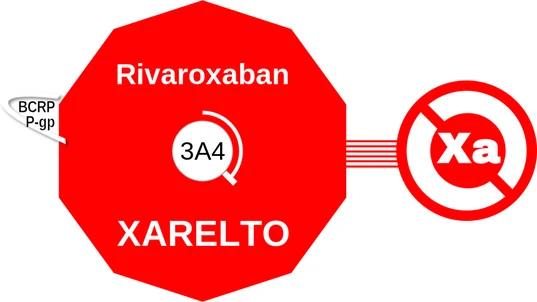
Mechanism of action: Rivaroxaban ballicule
Open Rivaroxaban in the interactive console ↗
Memory aids: mascots and interaction avatars