P-gp interactions
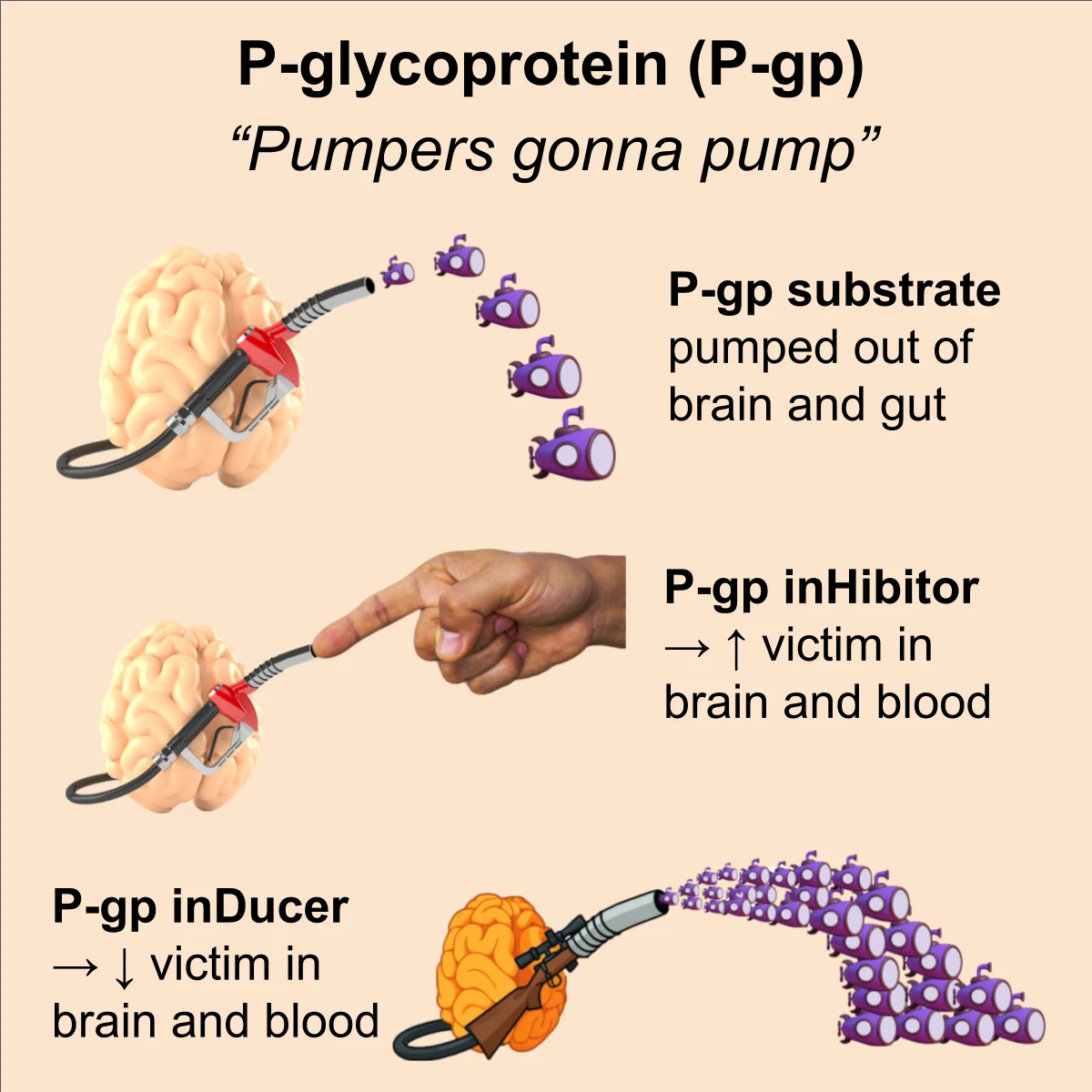
P-glycoprotein is an efflux pump that throws its substrates back into the gut lumen, out of the brain, and into bile and urine before they can act.
It is co-regulated with CYP3A4 by the same nuclear receptors, so most P-gp inhibitors and inducers are also CYP3A4 inhibitors and inducers — and the two effects add rather than cancel. The substrates overlap far less, which is why a P-gp interaction can appear in a drug that has no CYP metabolism at all.
Digoxin is the textbook victim: quinidine, verapamil, cyclosporine, ketoconazole and ritonavir raise its level, and rifampin, carbamazepine, phenytoin, phenobarbital, primidone and St John’s wort lower it. The direct oral anticoagulants dabigatran, apixaban, rivaroxaban and edoxaban are the modern equivalent, and dabigatran is the purest case because P-gp is essentially its only interaction route.
Loperamide shows what the barrier is for. It is a potent opioid that normally never reaches the brain because P-gp pumps it back out; taken in large doses with a P-gp inhibitor such as verapamil or quinidine, it produces central opioid effects and marked QT prolongation. Colchicine, tacrolimus, sirolimus, cyclosporine, paclitaxel, aliskiren and glecaprevir are the other substrates shown.
Cyclosporine and quinidine appear as both substrate and inhibitor, which is the usual signature of a drug that competes for the pump rather than disabling it. P-gp effects are less well quantified than CYP ones, so treat a suspected P-gp interaction as a reason to monitor rather than as a predictable fold change.
P-gp inhibitors (6)

P-gp inhibitor

P-gp inhibitor

P-gp inhibitor

P-gp inhibitor
P-gp inhibitor

P-gp inhibitor
P-gp inducers (6)

P-gp inducer
P-gp inducer

P-gp inducer

P-gp inducer

P-gp inducer
P-gp inducer
P-gp substrates (14)

P-gp substrate

P-gp substrate

P-gp substrate

P-gp substrate
P-gp substrate
P-gp substrate
P-gp substrate
P-gp substrate
P-gp substrate
P-gp substrate

P-gp substrate

P-gp substrate
P-gp substrate
P-gp substrate