Methadone
DOLOPHINE
What it isLong-acting full mu-opioid agonist; opioid use disorder and chronic pain.
Why this oneIts long duration suppresses withdrawal and craving between clinic doses and can retain patients for whom buprenorphine is inadequate.
What limits itDelayed accumulation can cause fatal respiratory depression during titration; QT prolongation and numerous CYP interactions complicate use.
FDA-approved for
- opioid use disorder (~1972)
- pain (~1947)
FDA label
Read the full label on DailyMed ↗
| FDA dosing | Population | Start | Target | Max |
|---|---|---|---|---|
| Pain (opioid-tolerant, conversion from other opioids) | adult | conversion-based per Table 1 (20-30% of oral morphine-equiv <100 mg/day, less at higher) | individualized | individualized |
| Opioid detoxification / maintenance | adult | 20-30 mg single dose (initial dose not to exceed 30 mg) may suppress withdrawal; may add 5-10 mg after 2-4 h if symptoms persist; day-1 total should not ordinarily exceed 40 mg | Maintenance: dose that prevents withdrawal for 24 h, reduces craving and blocks euphoric effects - clinical stability most commonly at 80-120 mg/day (OTP-directed) | Day 1: 40 mg; thereafter individualized (OTP-directed) |
Titration Pain: increase no more frequently than every 3 to 5 days (steady state not reached before then); some patients require up to 12 days between increases
Renal Undefined
Hepatic Undefined
Peak respiratory depressant effect occurs later and lasts longer than peak analgesic effect; drug accumulates with repeated dosing
Instructions
- Do not abruptly discontinue in physically dependent patients; taper gradually to avoid withdrawal
- Consider prescribing opioid overdose reversal agent (naloxone/nalmefene)
- For addiction, dispense only through certified opioid treatment programs (with limited emergency/inpatient exceptions)
- Avoid overestimating dose when converting from other opioids; underestimate and use rescue medication
- Pain taper (physically dependent patients): reduce by no more than 10-25% of the total daily dose, no more often than every 2 to 4 weeks
- Short-term detoxification: stabilize at about 40 mg/day in divided doses for 2-3 days, then decrease daily or every 2 days keeping withdrawal tolerable (hospitalized patients may tolerate 20%/day reduction)
- Medically supervised withdrawal after maintenance: dose reductions generally less than 10% of the maintenance dose, with 10-14 day intervals between reductions
- Pregnancy: methadone clearance may increase - the dose may need to be increased or the dosing interval decreased
- Acute pain during methadone maintenance: existing methadone dose gives no analgesia; treat with analgesics (incl. opioids), often at somewhat higher/more frequent doses than in non-tolerant patients
Contraindications
- Significant respiratory depression
- Acute or severe bronchial asthma in unmonitored setting or without resuscitative equipment
- Known or suspected GI obstruction, including paralytic ileus
Cautions
- QT prolongation
- MAOIs due to risk of serotonin syndrome
- Adrenal insufficiency
- Severe hypotension; avoid in circulatory shock
- Opioid-induced hyperalgesia
- Risk in chronic pulmonary disease and elderly/cachectic/debilitated patients
- Risk with increased intracranial pressure/head injury
Adverse reactions
- Respiratory depression
- Hypotension
- Lightheadedness, dizziness, sedation
- Nausea, vomiting
- Sweating
Pregnancy No clear increased malformation risk; NOWS expected and treatable after prolonged use in pregnancy
Lactation Present in milk; monitor breastfed infant for drowsiness and breathing difficulties
⚠ BOXED WARNINGS
- Addiction, abuse and misuse
- Life-threatening respiratory depression
- QT prolongation and serious arrhythmias
- Risk from concomitant use with benzodiazepines
Cost, est. cash$10–$300/month
Generic entry1982
Classes and tags
Clinical profile
Legacy pregnancy categoryC
Defining liabilityRespiratory depression, dependence and overdose; risk rises sharply with sedatives or impaired clearance.
Mechanism of action: Methadone ballicule
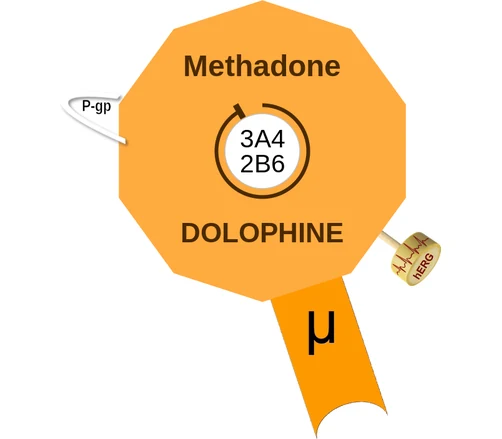
Open Methadone in the interactive console ↗
Memory aids: mascots and interaction avatars

pinpoint pupils → opioid
QT prolongation