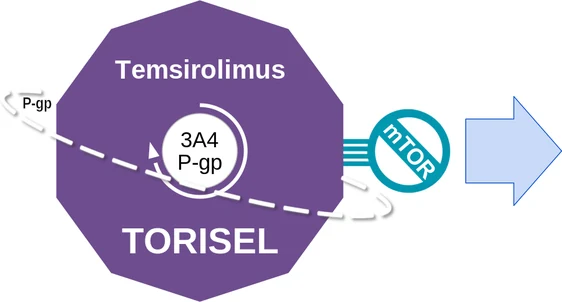
Temsirolimus
TORISEL
What it isIV mTOR inhibitor; advanced renal-cell carcinoma.
Why this oneIts established niche is poor-risk advanced renal-cell carcinoma when an IV option is preferable.
What limits itPremedicate for infusion reactions; immunosuppression, metabolic toxicity, pneumonitis, and CYP3A interactions restrict use.
FDA-approved for
- advanced renal cell carcinoma (2007)
Off-label
- mTOR-pathway epilepsies (rarely; everolimus is the agent with the TSC indication)
FDA label
Read the full label on DailyMed ↗
| FDA dosing | Population | Start | Target | Max |
|---|---|---|---|---|
| Advanced renal cell carcinoma | Adults | 25 mg IV weekly | 25 mg IV weekly | 25 mg weekly |
Renal Undefined
Hepatic Mild impairment (bilirubin >1–1.5×ULN or AST >ULN with bilirubin ≤ULN): reduce to 15 mg/week; contraindicated if bilirubin >1.5×ULN
Instructions
- IV infusion over 30–60 minutes once weekly until progression or unacceptable toxicity
- Premedicate with IV diphenhydramine 25–50 mg ~30 min before each dose
- Dilute vial with enclosed diluent, then in 250 mL 0.9% NaCl
- Hold for ANC <1000, platelets <75,000, or grade ≥3 toxicity; on recovery resume reduced by 5 mg/week (floor 15 mg/week)
Contraindications
- Bilirubin >1.5×ULN
Cautions
- Hypersensitivity/infusion reactions (rarely fatal)
- Hyperglycemia and hyperlipidemia — monitor glucose and lipids
- Immunosuppression / infections
- Interstitial lung disease — discontinue if suspected
- Bowel perforation; renal failure (sometimes fatal); intracerebral hemorrhage
- Impaired wound healing; proteinuria/nephrotic syndrome; avoid live vaccines
Adverse reactions
- Rash, asthenia, mucositis, nausea, edema, anorexia; anemia, hyperglycemia, hyperlipidemia, lymphopenia
Pregnancy Can cause fetal harm (animal data, mechanism) — advise of hazard
Lactation Do not breastfeed during treatment and for 3 weeks after final dose
NO BOXED WARNINGS
Principal risksevere infusion hypersensitivity
Cost, est. cash$50–$10,000/month or cycle
Generic entry2018
Classes and tags
Clinical profile
Legacy pregnancy categoryD
Defining liabilityMyelosuppression and agent-specific hepatic, cardiac, pulmonary, neurologic or reproductive toxicity require oncology monitoring.
Active metabolites
Mechanism of action: Temsirolimus ballicule