Tavapadon
JUVMO
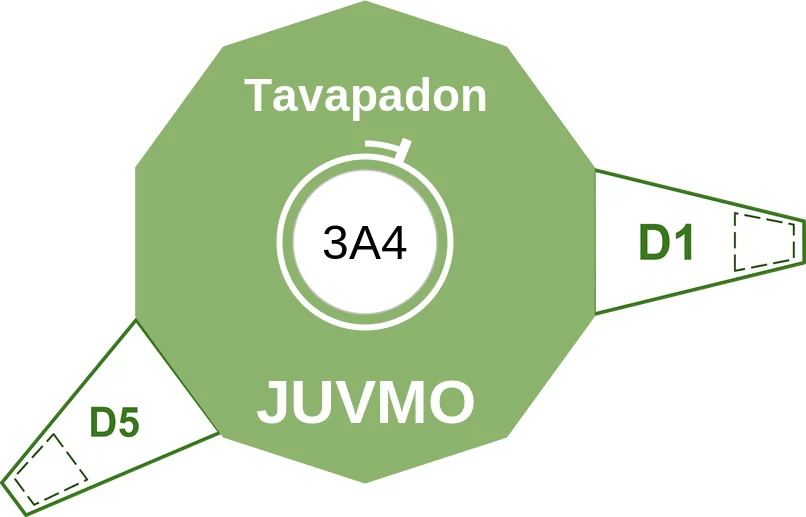

“Vapor Don, Move mo'”
For Parkinson disease
Green → dopamine-related
What it isSelective D1/D5 partial agonist; Parkinson disease in adults.
Why this oneStimulates the direct-pathway D1 receptor instead of D2/D3, once daily (t½ ~25.5 h). Unlike ropinirole, its label carries no warning for falling asleep during daily activities.
What limits itOrthostatic hypotension, impulse-control disorders and hallucinations; worsens dyskinesia with levodopa. CYP3A substrate (itraconazole raises exposure 5-fold) that induces CYP3A and inhibits CYP2C8 and BCRP.
FDA-approved for
- Parkinson disease (2026)
NO BOXED WARNINGS
Principal riskOrthostatic hypotension during titration; impulse-control disorders; hallucinations
Why D1 agonists took 40 years
D1 agonists worked in Parkinson disease. They could not be used.
D1 drives the direct (“go”) pathway — every older dopamine agonist targets D2/D3 instead
- A full D1 agonist, ABT-431, matched levodopa’s motor benefit
- Every one was a catechol — the ring the body clears in minutes (dihydrexidine: t½ < 5 min, given IV)
- Dose-limiting hypotension, flushing and tachycardia
- Levodopa-like dyskinesia
- Tolerance: A-77636 lost its benefit by day 2 in parkinsonian monkeys
Fenoldopam, the one marketed D1 agonist, acts only peripherally — an IV antihypertensive
The fix: no catechol
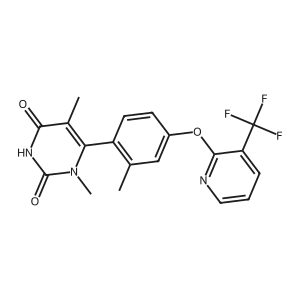
Tavapadon has no catechol ring.
- Catechol = dopamine’s two adjacent hydroxyls: the D1 binding handle, and the target for rapid breakdown
- A Pfizer screen found the first D1 agonists without one (PF-06649751 → CVL-751 → tavapadon)
- Oral, brain-penetrant, t½ ~25.5 h → once daily; cleared by CYP3A
- Cryo-EM: one elongated molecule reaches from dopamine’s pocket into an extended pocket toward the cell surface
- A lighter grip on the TM5 serines that hold dopamine’s hydroxyls
Blood pressure still falls — orthostatic hypotension is a label warning
Partial, not full
About two-thirds of dopamine’s maximum at D1.
- Intrinsic activity 65% at D1, 81% at D5 (sponsor data, unpublished)
- The aim: enough D1 drive for movement, without a full agonist’s overstimulation
- Never tested head to head, and dyskinesia was not designed away — the label warns it can cause or worsen dyskinesia with levodopa
- D5: sparse in striatum, mainly on cholinergic interneurons; clinical role unknown
Biased agonism: the claim and the evidence
Often called G-protein-biased. The one direct test found no bias.
- Catechol D1 agonists recruit β-arrestin → receptor internalization → tolerance
- Sister non-catechols from the same Pfizer series recruit little β-arrestin, and kept working in monkeys where A-77636 faded
- Tavapadon itself, tested independently: no signaling bias at the normal D1 receptor
- Bias hinges on how close the drug sits to TM5: mutating one serine there swings tavapadon toward β-arrestin
Why its benefit does not fade as the catechols’ did is unsettled
Tavapadon against the catechol D1 agonists
| Catechol full D1 agonists | Tavapadon (JUVMO) | |
|---|---|---|
| Catechol ring | yes | no |
| Route, half-life | injectable; minutes (dihydrexidine < 5 min) | oral, once daily; ~25.5 h |
| Efficacy at D1 | full | partial, ~65% |
| Motor benefit | ABT-431 ≈ levodopa | early PD alone, and added to levodopa |
| Tolerance | by day 2 (A-77636, monkeys) | benefit measured at 26 weeks |
| Dyskinesia | levodopa-like (ABT-431) | can cause or worsen it with levodopa |
| Blood pressure | dose-limiting hypotension | orthostatic hypotension warning |
| β-arrestin | recruited | recruited; no bias shown |
The trials (label)
| Study | Patients | Tavapadon vs placebo, week 26 |
|---|---|---|
| 1 (TEMPO-1) | early PD, no levodopa; 5 or 15 mg | MDS-UPDRS II −2.5 (5 mg), −2.6 (15 mg) |
| 2 (TEMPO-2) | early PD, no levodopa; 5–15 mg | MDS-UPDRS II −1.5 |
| 3 (TEMPO-3) | on levodopa, with OFF time; 5–15 mg | ON time without troublesome dyskinesia +1.1 h/day; OFF −0.9 h/day |
Early-PD studies: 20% stopped for adverse reactions, 85% of them during titration
Sources
- JUVMO prescribing information — half-life, warnings, trials
- Rascol 1999, Rascol 2001 — ABT-431 efficacy and dyskinesia
- Blanchet 1998 — dihydrexidine in PD
- Blanchet 1996 — A-77636 tolerance
- Gray 2018 — non-catechol D1 agonists, β-arrestin
- Teng 2022 — cryo-EM (PDB 7X2D), bias testing
- Bezard 2024 — sponsor review, intrinsic activity
- Murphy 2001 — fenoldopam
Classes and tags
Clinical profile
Open Tavapadon in the interactive console ↗
Memory aids: interaction avatars