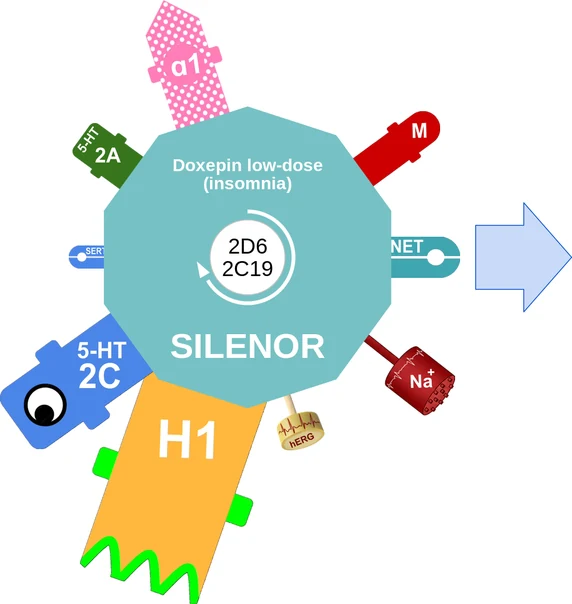
Doxepin low-dose (insomnia)
SILENOR
What it isLow-dose doxepin 3/6 mg, a tricyclic whose H1 antagonism treats sleep-maintenance insomnia.
Why this oneAt insomnia exposure it acts mainly as an antihistamine, with less antimuscarinic burden than antidepressant-dose doxepin.
What limits itNext-day sedation and additive CNS depression can impair driving; the antidepressant suicidality warning remains.
FDA-approved for
- insomnia (sleep maintenance) (2010)
FDA label
Read the full label on DailyMed ↗
| FDA dosing | Population | Start | Target | Max |
|---|---|---|---|---|
| Insomnia (sleep maintenance) | Adults | 6 mg once daily (3 mg may be appropriate) | 6 mg QHS | 6 mg/day |
| Insomnia (sleep maintenance) | Elderly (≥65 y) | 3 mg once daily | 3 mg QHS (may increase to 6 mg) | 6 mg/day |
Renal Undefined (not studied; not expected to significantly alter concentrations)
Hepatic Initiate at 3 mg (hepatic impairment); monitor for daytime effects
Instructions
- Take within 30 minutes of bedtime
- Do not take within 3 hours of a meal
- Total dose should not exceed 6 mg/day
- With cimetidine, max dose 3 mg
Contraindications
- Co-administration with monoamine oxidase inhibitors (MAOIs) — do not administer if taking MAOIs or used within the past two weeks
- Untreated narrow angle glaucoma or severe urinary retention
Cautions
- Evaluate for comorbid diagnoses if insomnia persists after 7-10 days
- Abnormal thinking/behavioral changes including sleep-driving and hallucinations
- Worsening of depression or suicidal thinking
- CNS-depressant effects; avoid hazardous activities; do not use with alcohol
- Additive effects with CNS depressants/sedating antihistamines
- Not recommended in severe sleep apnea
Adverse reactions
- Somnolence/sedation
- Nausea
- Upper respiratory tract infection/nasopharyngitis
Pregnancy Epidemiologic data have not established increased risk of major birth defects; third-trimester TCA exposure risks poor neonatal adaptation
Lactation Doxepin present in human milk; excess sedation, respiratory depression, hypotonia reported — breastfeeding not recommended
⚠ BOXED WARNING
- Suicidal thoughts and behaviors in patients under 25
Classes and tags
Clinical profile
Active metabolites
Mechanism of action: Doxepin low-dose (insomnia) ballicule
Open Doxepin low-dose (insomnia) in the interactive console ↗
Memory aids: mascots and interaction avatars



Open Doxepin low-dose (insomnia) in the interactive console ↗