Risperidone
RISPERDAL
What it isD2 and broad serotonin-receptor antagonist; schizophrenia, bipolar mania, and irritability in autism.
Why this oneIts active metabolite is paliperidone, and its oral and long-acting formulations make continuity unusually flexible.
What limits itProlactin rises more than with any other second-generation agent; extrapyramidal effects become prominent as dose rises.
FDA-approved for
- schizophrenia (1993)
- bipolar mania (2003)
- irritability in autism (2006)
Off-label
- aggression
- Tourette
FDA label
Read the full label on DailyMed ↗
| FDA dosing | Population | Start | Target | Max |
|---|---|---|---|---|
| Schizophrenia | Adults | 2 mg/day (QD or BID) | 4-8 mg/day | 16 mg/day |
| Schizophrenia | Adolescents 13-17 yr | 0.5 mg QD | 3 mg/day | 6 mg/day |
| Bipolar mania | Adults | 2-3 mg/day | 1-6 mg/day | 6 mg/day |
| Bipolar mania | Children/adolescents 10-17 yr | 0.5 mg QD | 1-2.5 mg/day | 6 mg/day |
| Irritability associated with autistic disorder | Pediatric >=5 yr | 0.25 mg/day (<20 kg) or 0.5 mg/day (>=20 kg) | 0.5 mg/day (<20 kg) or 1 mg/day (>=20 kg) | 3 mg/day |
Titration Schizophrenia/bipolar: increase at intervals >=24 h; autistic disorder irritability: increase at intervals >=2 weeks
Renal Severe (CrCl <30 mL/min): start 0.5 mg BID; increase in <=0.5 mg BID increments, intervals >=1 week for doses above 1.5 mg BID
Hepatic Severe (Child-Pugh 10-15): start 0.5 mg BID; titrate as in severe renal impairment
Instructions
- Oral solution taken directly from calibrated syringe or mixed with water, coffee, orange juice, or low-fat milk (not cola or tea)
- M-TAB orally disintegrating tablet: place on tongue immediately after opening blister; do not split or chew
- With strong CYP2D6 inhibitors (fluoxetine, paroxetine) reduce dose; do not exceed 8 mg/day in adults
- With enzyme inducers (e.g., carbamazepine) up to double the usual dose; adjust when inducer is stopped
Cautions
- Cerebrovascular events, including stroke, in elderly patients with dementia-related psychosis
- Neuroleptic malignant syndrome
- Tardive dyskinesia
- Metabolic changes: hyperglycemia/diabetes, dyslipidemia, weight gain
- Hyperprolactinemia
- Orthostatic hypotension
- Leukopenia, neutropenia, agranulocytosis
- Cognitive and motor impairment
- Seizures
Adverse reactions
- Parkinsonism
- Akathisia
- Dystonia
- Tremor
- Sedation
- Dizziness
- Anxiety
- Blurred vision
- Nausea/vomiting
- Abdominal pain, dyspepsia, constipation
- Salivary hypersecretion
- Increased appetite/weight
- Fatigue
- Nasal congestion, URI, nasopharyngitis
Pregnancy No established drug-associated risk of major birth defects; third-trimester exposure risks neonatal extrapyramidal/withdrawal symptoms.
Lactation Present in human milk (relative infant dose 2.3-4.7%); monitor infant for sedation, EPS, failure to thrive, jitteriness.
⚠ BOXED WARNING
- Increased mortality in elderly patients with dementia-related psychosis
Cost, est. cash$300–$5,000/dose or month
Generic entry2008
Classes and tags
Clinical profile
Legacy pregnancy categoryC
Defining liabilityMetabolic effects, extrapyramidal symptoms/tardive dyskinesia and agent-specific QT or orthostatic risk.
Active metabolites
Mechanism of action: Risperidone ballicule
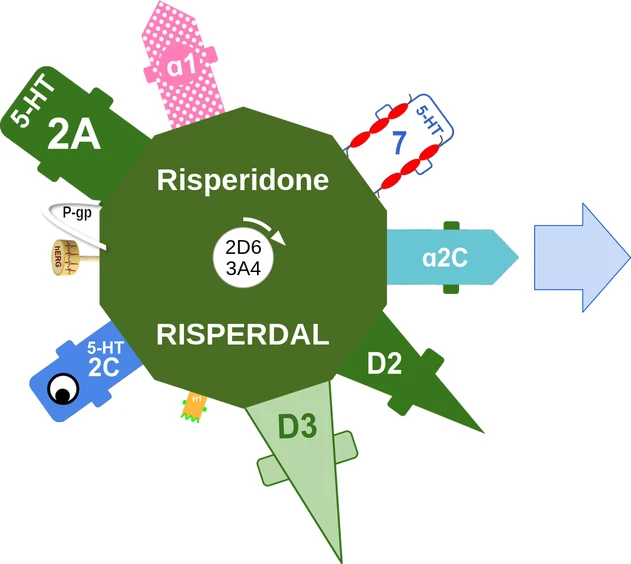
Open Risperidone in the interactive console ↗
Memory aids: mascots and interaction avatars

Spooky mascot → antipsychotic
May increase prolactin → gynecomastia risk