Quinidine
QUINIDEX
What it isClass IA antiarrhythmic; Brugada syndrome and, with dextromethorphan, pseudobulbar affect.
Why this oneIt is one of the few agents for Brugada syndrome, and it is a potent CYP2D6 inhibitor used deliberately to block dextromethorphan metabolism.
What limits itQT prolongation and cinchonism. It raises digoxin levels; excess mortality when used for ordinary arrhythmia.
FDA-approved for
- arrhythmias (~1950)
FDA label
Read the full label on DailyMed ↗
| FDA dosing | Population | Start | Target | Max |
|---|---|---|---|---|
| Conversion of symptomatic atrial fibrillation/flutter to sinus rhythm (after ventricular rate control has failed) | Adult | 400 mg (2 tablets) q6h | If no conversion after 4-5 doses, cautiously increase; discontinue if not converted in reasonable time | Gated by ECG limits (QRS/QTc widening to 130% of pretreatment, QTc >500 ms) |
| Reduction of frequency of relapse into atrial fibrillation/flutter (high-risk symptomatic patients) | Adult | 200 mg q6h | Cautiously raise if tolerated, level within therapeutic range, and inter-episode time not satisfactorily increased | Reduce total daily dose for QRS/QTc widening to 130% of pretreatment, P-wave disappearance, tachy-/bradycardia, or hypotension |
| Suppression of recurrent life-threatening ventricular arrhythmias (e.g., sustained VT) | Adult | Regimens not adequately studied; generally similar to 200 mg q6h | Guide by programmed electrical stimulation and/or Holter with exercise where possible | Same ECG-gated limits |
| Life-threatening P. falciparum malaria | Adult & peds | Part of approved regimen centered on Quinidine Gluconate Injection (see that label) | Per gluconate injection regimen | Per gluconate injection regimen |
Titration Conversion of A-fib/flutter: increase only after 4-5 doses without conversion; relapse prevention: raise only if regimen well tolerated and serum level still well within therapeutic range
Renal No specific adjustment given; renal dysfunction slows quinidine elimination — can lead to toxicity unless dosage appropriately reduced
Hepatic No specific adjustment given; hepatic dysfunction slows quinidine elimination — can lead to toxicity unless dosage appropriately reduced
200 mg quinidine sulfate = 166 mg quinidine base; 400 mg = 332 mg base
Instructions
- Initiate or adjust dose in a setting with continuous monitoring and resuscitation facilities, especially with structural heart disease or other toxicity risk factors
- Use for A-fib/flutter only after ventricular rate control (e.g., digitalis, beta-blockers) has failed to control symptoms
- Discontinue/reduce if QRS widens to 130% of pretreatment, QTc widens to 130% and exceeds 500 ms, P waves disappear, or significant tachycardia, symptomatic bradycardia, or hypotension develops
- Continue monitoring 2-3 days after initiating the discharge regimen
- A single recurrence of tachyarrhythmia is not therapeutic failure — goal is increased time between episodes
Contraindications
- Thrombocytopenic purpura during prior therapy with quinidine or quinine
- Cardiac rhythm dependent on a junctional or idioventricular pacemaker (incl. complete AV block) without a functioning artificial pacemaker
- Patients who might be adversely affected by an anticholinergic agent (e.g., myasthenia gravis)
Cautions
- Increased mortality: in trials for non-life-threatening arrhythmias, quinidine mortality was >3x placebo (atrial flutter/fib metaanalysis) and consistently greater than alternative antiarrhythmics for non-life-threatening ventricular arrhythmias
- Proarrhythmia: QTc prolongation and torsades de pointes — extreme care in preexisting long-QT, prior torsades, or prior marked QTc lengthening; risk increased by bradycardia, hypokalemia, hypomagnesemia, hypocalcemia, or high quinidine levels
- Paradoxical increase in ventricular rate in atrial flutter/fibrillation — consider prior AV-nodal blockade (digitalis, verapamil, diltiazem, beta-blocker)
- Marked sinus node depression and bradycardia in sick sinus syndrome
- Use with caution in patients at high risk of complete AV block without pacemaker (digitalis intoxication, second-degree AV block, severe intraventricular conduction defects)
- Vagal maneuvers to terminate paroxysmal SVT may be ineffective (vagolytic effect)
Adverse reactions
- Diarrhea (35%), upper GI distress (22%), nausea, vomiting, heartburn/esophagitis
- Lightheadedness (15%), headache (7%), fatigue (7%), palpitations (7%), angina-like pain (6%)
- Cinchonism: tinnitus, reversible high-frequency hearing loss, vertigo, blurred vision, diplopia, confusion, delirium
- Hepatotoxicity incl. granulomatous hepatitis (first weeks of therapy)
- Autoimmune/inflammatory: thrombocytopenic purpura, hemolytic anemia, vasculitis, lupus-like syndrome, fever, urticaria, agranulocytosis
- Syncope; rare acute psychotic reactions
Pregnancy Pregnancy Category C — no animal reproduction studies; no adequate human studies; give only if clearly needed; crosses to fetus (neonatal serum level equaled mother's in one case, no apparent ill effect)
Lactation Present in human milk slightly below maternal serum levels; avoid administration in lactating women who continue to nurse, if possible
⚠ BOXED WARNING
- Increased mortality in non-life-threatening arrhythmias
Cost, est. cash$20–$1,500/dose or month
Generic entry1982
Classes and tags
Clinical profile
Legacy pregnancy categoryC
Defining liabilityQT prolongation, torsades, cinchonism and extensive CYP2D6/P-gp interactions.
Mechanism of action: Quinidine ballicule
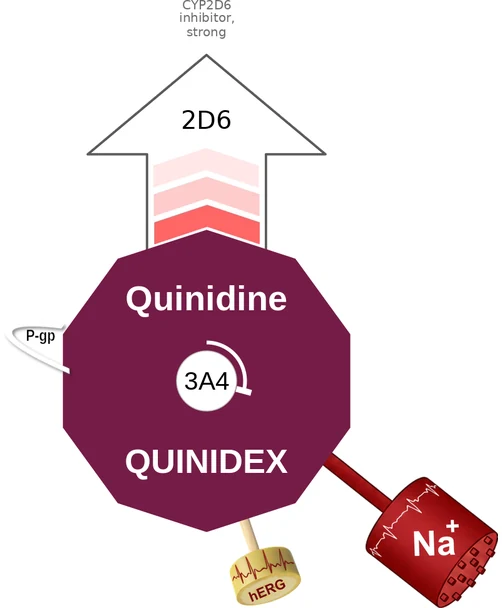
Open Quinidine in the interactive console ↗
Memory aids: mascots and interaction avatars