PEG 3350
MIRALAX
What it isOsmotic laxative that retains water in the lumen; constipation and bowel preparation.
Why this oneLack of bacterial fermentation means less gas than lactulose, helping make it the preferred chronic osmotic laxative.
What limits itOnset takes one to three days; large-volume bowel preparation can shift electrolytes in frail patients or kidney disease.
FDA-approved for
- constipation (1999)
FDA label
Read the full label on DailyMed ↗
| FDA dosing | Population | Start | Target | Max |
|---|---|---|---|---|
| Colonoscopy bowel preparation | Adults | 8 oz every 10 min | until 4 L consumed or rectal effluent clear | 4 L |
Renal Use with caution (risk of renal injury); ensure adequate hydration and consider baseline/post-procedure electrolytes, creatinine, BUN.
Hepatic Undefined
Complete the regimen the evening before colonoscopy; consume only clear liquids
Instructions
- Correct fluid and electrolyte abnormalities before treatment
- Reconstitute with water only to the 4-liter fill line; do not add other ingredients or starch-based thickeners
- Begin early evening the day before colonoscopy; drink 8 oz every 10 min until 4 L consumed or effluent clear
- Consume only clear liquids (avoid red/purple); no solid food within 2 h of starting
- No oral medications within 1 h before or during administration; no other laxatives
- Slow or temporarily stop if severe bloating, distention, or abdominal pain occurs
- Via nasogastric tube: 20–30 mL/min
Contraindications
- Gastrointestinal obstruction
- Bowel perforation
- Toxic colitis or toxic megacolon
- Gastric retention
- Ileus
Cautions
- Serious fluid and serum chemistry abnormalities
- Cardiac arrhythmias (consider ECGs in at-risk patients)
- Seizures (associated with electrolyte abnormalities)
- Renal impairment / risk of renal injury
- Colonic mucosal ulcerations and ischemic colitis
- Use with caution in significant GI disease / severe active ulcerative colitis
- Aspiration risk in impaired gag reflex
- Hypersensitivity reactions including anaphylaxis
Adverse reactions
- Nausea
- Abdominal fullness
- Bloating
- Abdominal cramps
- Vomiting
- Anal irritation
Pregnancy Animal studies not conducted; give to a pregnant woman only if clearly needed.
Lactation Unknown whether excreted in human milk; use caution in nursing women.
NO BOXED WARNINGS
Principal riskLittle; electrolyte shifts with prolonged use
Classes and tags
Clinical profile
Mechanism of action: PEG 3350 ballicule
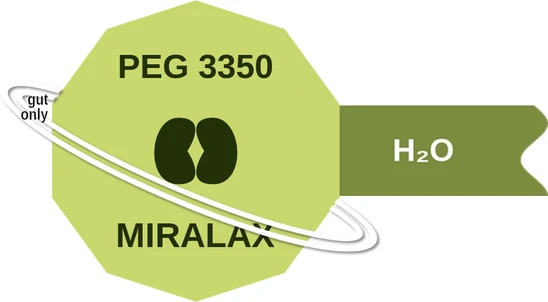
Open PEG 3350 in the interactive console ↗
Memory aids: mascots and interaction avatars