Oxycodone
oxycodone IR
What it isFull mu-opioid receptor agonist; moderate to severe pain.
Why this oneCYP2D6 affects only a minor pathway, so analgesia is less genotype-dependent than with codeine or tramadol.
What limits itRespiratory depression, constipation, tolerance and dependence follow sustained use; benzodiazepines sharply increase overdose risk.
FDA-approved for
- pain (1950)
FDA label
Read the full label on DailyMed ↗
| FDA dosing | Population | Start | Target | Max |
|---|---|---|---|---|
| Pain severe enough to require an opioid analgesic, alternatives inadequate (as first opioid) | Adults (opioid-naïve) | 5–15 mg q4–6h PRN | lowest dose providing adequate analgesia | no stated ceiling — titrate balancing analgesia vs adverse reactions |
Renal Initiate at lower than usual dosage and titrate carefully (clearance may decrease); monitor for respiratory depression, sedation, hypotension
Hepatic Initiate at lower than usual dosage and titrate carefully (extensively hepatically metabolized); monitor for respiratory depression, sedation, hypotension
Instructions
- Use lowest effective dosage for shortest duration; many acute pain conditions need no more than a few days
- Converting from other opioids: use conservative estimates — safer to underestimate the 24-h dose
- Do not rapidly reduce or abruptly discontinue in physically dependent patients (risk of withdrawal, uncontrolled pain, suicide) — taper gradually
- Discuss access to an opioid overdose reversal agent (naloxone/nalmefene) when initiating and renewing
- Elderly: start at low end of dosing range (greater sensitivity, decreased organ function)
Contraindications
- Significant respiratory depression
- Acute or severe bronchial asthma in an unmonitored setting or in the absence of resuscitative equipment, or hypercarbia
- Known or suspected gastrointestinal obstruction, including paralytic ileus
Cautions
- Addiction, abuse, and misuse — can occur at recommended dosages; assess risk before prescribing and reassess regularly
- Life-threatening respiratory depression, especially at initiation and after dose increases; heightened risk in chronic pulmonary disease and elderly, cachectic, or debilitated patients
- Profound sedation, respiratory depression, coma, death with benzodiazepines or other CNS depressants (incl. alcohol)
- Neonatal opioid withdrawal syndrome with extended use in pregnancy
- Opioid-induced hyperalgesia and allodynia — consider dose reduction or rotation
- Adrenal insufficiency; severe hypotension (avoid in circulatory shock)
- Avoid in impaired consciousness/coma; caution with increased ICP, brain tumors, head injury
- Seizures — may increase frequency in seizure disorders
- Withdrawal on rapid discontinuation in physically dependent patients
Adverse reactions
- Nausea
- Constipation
- Vomiting
- Headache
- Pruritus
- Insomnia
- Dizziness
- Asthenia
- Somnolence
Pregnancy Extended use during pregnancy can cause neonatal opioid withdrawal syndrome (may be life-threatening); insufficient data on birth defects/miscarriage
Lactation Present in breastmilk (milk:plasma ~3.2); IR doses <60 mg/day unlikely to give clinically relevant infant exposure; monitor breastfed infants for excess sedation and respiratory depression
⚠ BOXED WARNINGS
- Addiction, abuse and misuse
- Life-threatening respiratory depression
- Risk from concomitant use with benzodiazepines
Cost, est. cash$300–$2,500/month
Generic entry2036 est.
Classes and tags
Clinical profile
Legacy pregnancy categoryNot assigned — PLLR-era drug
Defining liabilityRespiratory depression, dependence and overdose; risk rises sharply with sedatives or impaired clearance.
Mechanism of action: Oxycodone ballicule
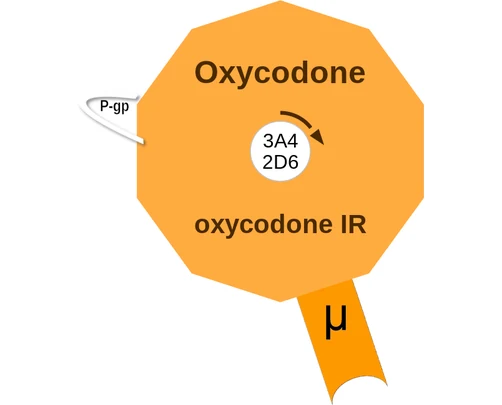
Open Oxycodone in the interactive console ↗
Memory aids: mascots and interaction avatars