Nevirapine
VIRAMUNE
What it isNon-nucleoside reverse-transcriptase inhibitor; HIV infection.
Why this oneIts durable niche is neonatal prophylaxis after perinatal HIV exposure, especially where newer agents are unavailable.
What limits itSevere rash and hepatotoxicity can be fatal; a lead-in phase reduces rash, and enzyme induction creates major interactions.
FDA-approved for
- HIV infection (1996)
FDA label
Read the full label on DailyMed ↗
| FDA dosing | Population | Start | Target | Max |
|---|---|---|---|---|
| HIV-1 infection (with other antiretrovirals) | adult (≥16 yr) | 200 mg QD × 14 days (lead-in) | 200 mg BID | 400 mg/day |
| HIV-1 infection (with other antiretrovirals) | pediatric ≥15 days | 150 mg/m² QD × 14 days (lead-in) | 150 mg/m² BID | 400 mg/day |
Titration Escalate to BID after the 14-day 200 mg once-daily lead-in (do not escalate if rash present; lead-in must not exceed 28 days)
Renal No adjustment if CrCl ≥20 mL/min; on hemodialysis give an additional 200 mg after each session
Hepatic Contraindicated in moderate or severe (Child-Pugh B or C) impairment
Instructions
- Strictly follow the 14-day 200 mg once-daily lead-in to reduce rash
- If dosing is interrupted for >7 days, restart with the 14-day lead-in
- Permanently discontinue for a symptomatic hepatic event or severe rash/hypersensitivity; do not restart after recovery
- Must not be used as monotherapy
- Oral suspension (50 mg/5 mL) available for pediatric dosing (same 150 mg/m²)
Contraindications
- Moderate or severe (Child-Pugh B or C) hepatic impairment
- Use as part of occupational or non-occupational post-exposure prophylaxis (PEP)
Cautions
- Severe/fatal hepatotoxicity (greatest first 6–18 weeks; higher risk in women and higher CD4+)
- Severe skin reactions (SJS/TEN, hypersensitivity)
- Immune reconstitution syndrome
- Fat redistribution
- Rapid resistance if used as monotherapy
Adverse reactions
- Rash (15%; Grade 3/4 in 2%)
- Hepatitis/hepatotoxicity
- Nausea
- Headache
- Fatigue
- Granulocytopenia (pediatric)
Pregnancy APR data show no increased overall birth-defect risk; severe hepatic events reported in pregnant women, especially CD4+ >250
Lactation Present in human milk; CDC advises HIV-infected mothers in the US not to breastfeed
⚠ BOXED WARNINGS
- Severe hepatotoxicity
- Severe skin reactions
Cost, est. cash$10–$500/month
Generic entry2012
Classes and tags
Clinical profile
Legacy pregnancy categoryUnknown / historical label unavailable
Defining liabilityAgent-specific renal, hepatic, hematologic, metabolic and drug-interaction toxicity.
Mechanism of action: Nevirapine ballicule
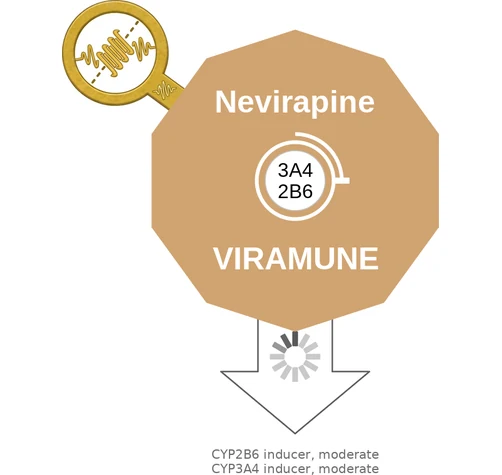
Open Nevirapine in the interactive console ↗
Memory aids: mascots and interaction avatars