Methyl prednisolone
MEDROL
What it isGlucocorticoid-receptor agonist; systemic treatment of acute inflammatory and allergic conditions.
Why this oneLess mineralocorticoid activity than prednisone and ready IV use make it useful when edema or rapid parenteral treatment matters.
What limits itHyperglycemia, infection and mood effects appear early; prolonged use suppresses the adrenal axis and requires a thoughtful taper.
FDA-approved for
- inflammation (~1957)
FDA label
Read the full label on DailyMed ↗
| FDA dosing | Population | Start | Target | Max |
|---|---|---|---|---|
| All labeled corticosteroid-responsive conditions (initial dosing) | Adults | 4–48 mg/day PO, by disease severity | Lowest dose maintaining adequate clinical response | 48 mg/day per label range; higher initial doses in selected patients |
| Acute exacerbation of multiple sclerosis | Adults | Prednisolone 200 mg QD × 1 week (≈160 mg/day methylprednisolone) | Then prednisolone 80 mg QOD × 1 month (≈64 mg QOD methylprednisolone) | Per regimen above |
| Alternate-day therapy (ADT) — long-term maintenance | Adults and children | After control on daily dosing, convert to twice the usual daily dose every other morning | Gradually reduce the every-other-day dose to the minimum effective | Not specified |
Renal Undefined
Hepatic Undefined
Dexamethasone and betamethasone are NOT suitable for alternate-day therapy (prolonged adrenal suppression); methylprednisolone is short-acting (adrenal suppression 1¼–1½ days) and is.
Instructions
- Individualize dose to the disease and patient response; maintain or adjust the initial dose until satisfactory response, then reduce in small decrements at appropriate intervals to the lowest effective maintenance dose.
- After long-term therapy, withdraw gradually rather than abruptly.
- Discontinue and transfer to other therapy if there is no satisfactory response after a reasonable period.
- Increase the dose temporarily during stress (trauma, surgery, illness) or disease exacerbation.
- ADT: give every other morning — exogenous corticosteroid suppresses adrenocortical activity least when given at the time of maximal endogenous activity (AM).
- Keep the initial suppressive-dose period as brief as possible (usually 4–10 days in allergic and collagen disease) when ADT is intended.
- 4 mg methylprednisolone ≡ 5 mg prednisolone.
Contraindications
- Systemic fungal infections
Cautions
- HPA-axis suppression: recovery time after pharmacologic dosing is variable and the patient is vulnerable to stress throughout — cover surgery, trauma, illness.
- Do not stop abruptly after long-term therapy — corticoid withdrawal syndrome.
- Cushingoid state, growth suppression in children, osteoporosis, latent diabetes, electrolyte imbalance with prolonged pharmacologic dosing.
- May suppress reactions to skin tests.
- Symptom flare can occur in the latter part of the off-steroid day on ADT; counsel patients.
Adverse reactions
- Fluid/electrolyte: sodium and fluid retention, potassium loss, hypokalemic alkalosis, hypertension, CHF in susceptible patients
- Musculoskeletal: muscle weakness/wasting, steroid myopathy, osteoporosis, vertebral compression fracture, aseptic necrosis of femoral/humeral heads, tendon rupture (esp. Achilles)
- GI: peptic ulcer with perforation/hemorrhage, pancreatitis, abdominal distention, ulcerative esophagitis, transaminase/alk phos elevation (small, reversible)
- Endocrine: Cushingoid state, growth suppression in children, secondary adrenocortical/pituitary unresponsiveness, menstrual irregularity, decreased carbohydrate tolerance, latent diabetes unmasked, increased insulin/oral hypoglycemic requirement
- Ophthalmic: posterior subcapsular cataract, increased intraocular pressure, glaucoma, exophthalmos
- Neurologic: increased intracranial pressure with papilledema (pseudotumor cerebri), convulsions, vertigo, headache
- Dermatologic: impaired wound healing, thin fragile skin, petechiae/ecchymoses, facial erythema, increased sweating
- Urticaria and other allergic, anaphylactic, or hypersensitivity reactions
Pregnancy Undefined
Lactation Undefined
NO BOXED WARNINGS
Principal riskAdrenal suppression with prolonged use
Cost, est. cash$4–$300/month
Generic entry1982
Classes and tags
Clinical profile
Legacy pregnancy categoryC
Defining liabilityHyperglycemia, infection, osteoporosis and potentially severe mood, sleep or psychotic effects.
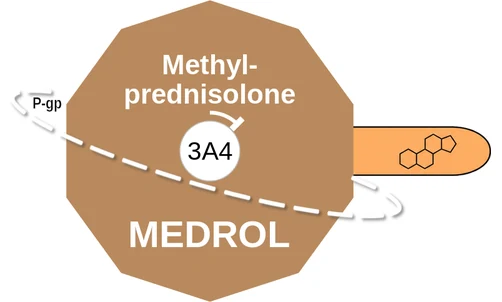
Mechanism of action: Methyl prednisolone ballicule
Open Methyl prednisolone in the interactive console ↗
Memory aids: mascots and interaction avatars

cushingoid moon face → corticosteroid