Mesalamine
PENTASA
What it isTopical colonic 5-aminosalicylate with PPAR-gamma agonism and 5-lipoxygenase inhibition; ulcerative colitis.
Why it mattersIt works locally, and each delivery system determines which bowel segment receives the drug.
What it changesInterstitial nephritis requires periodic creatinine monitoring. Formulations are not interchangeable because release sites differ.
FDA-approved for
- ulcerative colitis
FDA label
Read the full label on DailyMed ↗
| FDA dosing | Population | Start | Target | Max |
|---|---|---|---|---|
| Ulcerative colitis — induction (mild-moderate) | Adults | 2.4–4.8 g QD | 2.4–4.8 g QD | 4.8 g QD |
| Ulcerative colitis — maintenance | Adults | 2.4 g QD | 2.4 g QD | 2.4 g QD |
| Ulcerative colitis (mild-moderate) | Pediatric ≥24 kg | Wk 0–8: 2.4–4.8 g QD (weight-based) | After wk 8: 1.2–2.4 g QD (weight-based) | 4.8 g QD |
Renal Assess renal function before and periodically; weigh risk/benefit in impairment; discontinue if function deteriorates
Hepatic Weigh risk/benefit in known liver impairment (hepatic failure reported in pre-existing liver disease)
Instructions
- Swallow whole; do not split or crush
- Take with food
- Drink an adequate amount of fluids
Contraindications
- Hypersensitivity to salicylates or aminosalicylates
Cautions
- Renal impairment (interstitial nephritis, minimal change disease, rarely renal failure)
- Mesalamine-induced acute intolerance syndrome (mimics UC flare)
- Hypersensitivity reactions incl. myocarditis/pericarditis
- Hepatic failure in pre-existing liver disease
- Severe cutaneous adverse reactions (SJS/TEN, DRESS, AGEP)
- Upper GI obstruction (pyloric stenosis) delays release
- Photosensitivity
- Nephrolithiasis (radiotransparent mesalamine stones)
Adverse reactions
- Headache
- Flatulence
- Abnormal LFTs
- Abdominal pain
- Diarrhea
Pregnancy Published data have not reliably shown association with birth defects, miscarriage, or adverse outcomes
Lactation Present in human milk in small amounts; reports of infant diarrhea — monitor breastfed infant
NO BOXED WARNINGS
Principal riskInterstitial nephritis
Cost, est. cash$5–$150/month
Generic entry2004
Classes and tags
Clinical profile
Legacy pregnancy categoryUnknown / historical label unavailable
Defining liabilityGenerally tolerated at therapeutic doses; clinically important risks are agent-specific and increase with interactions or organ impairment.
Mechanism of action: Mesalamine ballicule
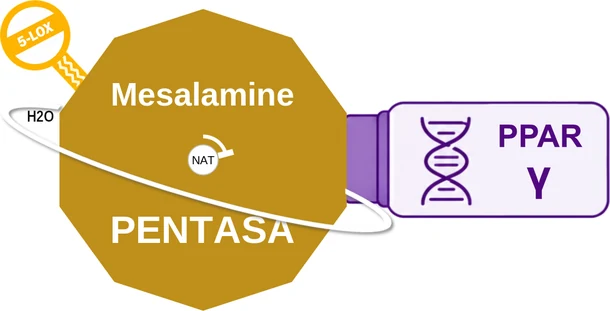
Open Mesalamine in the interactive console ↗
Memory aids: mascots and interaction avatars

Mesalamine (5-ASA) and aspirin (ASA) are both derivatives of salicylic acid
Pentasa release is time-dependent: hits small intestine and beyond
Asacol release is pH-dependent, delivering 5-ASA to colon