Efavirenz
SUSTIVA
What it isNon-nucleoside reverse-transcriptase inhibitor; HIV infection.
Why this oneIt anchored the first widely used single-tablet HIV regimen, leaving unusually deep global experience despite newer alternatives.
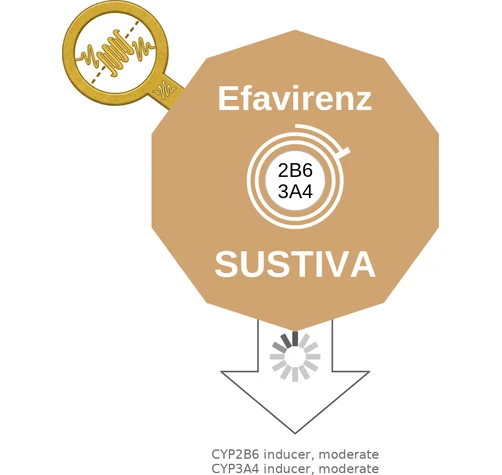
What limits itVivid dreams, dizziness, and depression worsen in CYP2B6 slow metabolizers; CYP3A4 induction reduces contraceptive efficacy.
FDA-approved for
- HIV infection (1998)
FDA label
Read the full label on DailyMed ↗
| FDA dosing | Population | Start | Target | Max |
|---|---|---|---|---|
| HIV-1 infection (in combination with other antiretrovirals) | Adults | 600 mg QD | 600 mg QD | 600 mg QD (800 mg QD with rifampin if >=50 kg) |
| HIV-1 infection (in combination with other antiretrovirals) | Pediatric patients >=40 kg | 600 mg QD | 600 mg QD | 600 mg QD |
Renal Undefined
Hepatic Not recommended in moderate or severe hepatic impairment (Child-Pugh B or C); mild impairment — no dose adjustment, use caution
Instructions
- Take once daily on an empty stomach, preferably at bedtime (food increases levels and adverse reactions; bedtime dosing improves CNS tolerability).
- Swallow tablets intact with liquid; tablets must not be broken or crushed.
- Must be given in combination with other antiretrovirals — never as a single agent or sole addition to a failing regimen (rapid resistance).
- With rifampin in patients >=50 kg: increase efavirenz to 800 mg QD.
- With voriconazole: decrease efavirenz to 300 mg QD using the capsule formulation and increase voriconazole to 400 mg q12h.
- Monitor hepatic function before and during treatment.
- Females of reproductive potential: pregnancy test before initiation; effective contraception (incl. barrier) during treatment and for 12 weeks after stopping.
Contraindications
- Coadministration with elbasvir/grazoprevir
Cautions
- Serious psychiatric symptoms: severe depression (2.4%), suicidal ideation (0.7%), suicide attempts, aggression, paranoid and manic reactions; postmarketing suicide, delusions, psychosis-like behavior, catatonia — seek immediate evaluation.
- Nervous system symptoms in 53%: dizziness, insomnia, impaired concentration, somnolence, abnormal dreams; begin days 1-2, usually resolve in 2-4 weeks; late-onset neurotoxicity (ataxia, encephalopathy) may occur months-years later, incl. with CYP2B6 polymorphisms; additive CNS effects with alcohol/psychoactive drugs.
- QTc prolongation: consider alternatives with drugs with known torsade risk or patients at higher risk.
- Embryo-fetal toxicity: avoid first-trimester use; avoid pregnancy on therapy.
- Hepatotoxicity incl. hepatic failure (a few cases without pre-existing liver disease): monitor LFTs, esp. with hepatitis B/C or hepatotoxic drugs.
- Rash 26%: usually onset within 1-2 weeks, resolves within 4 weeks; discontinue for severe rash; Grade 4 rash (erythema multiforme, SJS) 0.1%; rash more frequent/severe in pediatric patients.
- Convulsions: caution with history of seizures.
- Lipid elevations (total cholesterol, triglycerides): monitor before therapy and periodically.
- Do not coadminister with Atripla (contains efavirenz) unless needed for rifampin dose adjustment.
- Immune reconstitution syndrome; redistribution/accumulation of body fat.
Adverse reactions
- Impaired concentration
- Abnormal dreams
- Rash (26%)
- Dizziness (28%)
- Nausea
- Headache
- Fatigue
- Insomnia
- Vomiting
- Depression (19%)
- Anxiety (13%)
Pregnancy Avoid first-trimester use — retrospective neural tube defect reports and monkey malformations at near-human exposures; APR shows no overall increase in birth defects (2.3%); pregnancy registry 1-800-258-4263; pregnancy test before starting and contraception during + 12 weeks after.
Lactation Breastfeeding not recommended (risk of postnatal HIV-1 transmission).
NO BOXED WARNINGS
Principal riskVivid dreams and depression; it reduces contraceptive efficacy
Cost, est. cash$10–$500/month
Generic entry2016
Classes and tags
Clinical profile
Legacy pregnancy categoryUnknown / historical label unavailable
Defining liabilityAgent-specific renal, hepatic, hematologic, metabolic and drug-interaction toxicity.
Mechanism of action: Efavirenz ballicule
Open Efavirenz in the interactive console ↗
Memory aids: mascots and interaction avatars