Clobazam
ONFI
What it is1,5-benzodiazepine; Lennox-Gastaut, Dravet syndrome and adjunctive focal seizures.
Why this oneLess sedation than the 1,4-benzodiazepines at anticonvulsant doses.
What limits itTolerance to the anticonvulsant effect develops in many. CYP2C19 makes exposure vary severalfold; dependence as for the class.
FDA-approved for
- Lennox-Gastaut syndrome (2011)
FDA label
Read the full label on DailyMed ↗
| FDA dosing | Population | Start | Target | Max |
|---|---|---|---|---|
| Adjunctive treatment of seizures in Lennox-Gastaut syndrome | ≤30 kg body weight | 5 mg/day | 20 mg/day (BID; ≤5 mg may be QD) | 20 mg/day |
| Adjunctive treatment of seizures in Lennox-Gastaut syndrome | >30 kg body weight | 10 mg/day | 40 mg/day (BID) | 40 mg/day |
Titration Do not escalate more rapidly than weekly (steady state of clobazam/active metabolite takes 5-9 days).
Renal No adjustment needed for mild-to-moderate renal impairment (severe impairment/ESRD not studied)
Hepatic Mild-to-moderate (Child-Pugh 5-9): start 5 mg/day, titrate to half the usual weight-based dose; severe impairment not established
Instructions
- Doses above 5 mg/day given in two divided doses
- Tablets: give whole, broken along the score, or crushed and mixed in applesauce; with or without food
- Taper to discontinue: decrease total daily dose by 5-10 mg/day on a weekly basis
- Geriatric patients and CYP2C19 poor metabolizers: start 5 mg/day and titrate to half the usual dose
Cautions
- Somnolence and sedation; potentiated by other CNS depressants and alcohol
- Serious dermatological reactions (Stevens-Johnson syndrome, toxic epidermal necrolysis)
- DRESS/multiorgan hypersensitivity
- Suicidal behavior and ideation
- Neonatal sedation and withdrawal syndrome with late-pregnancy use
- Physical dependence and withdrawal (including seizures/status epilepticus with abrupt discontinuation)
- Abuse, misuse, and addiction
Adverse reactions
- Constipation
- Somnolence/sedation
- Pyrexia
- Lethargy
- Drooling
- Ataxia
- Aggression
- Upper respiratory tract infection
Pregnancy Late-pregnancy use can cause neonatal sedation and/or withdrawal; animal studies show developmental toxicity (fetal malformations, mortality) below therapeutic exposures.
Lactation Excreted in human milk; reports of sedation, poor feeding, and poor weight gain in exposed infants — monitor.
⚠ BOXED WARNINGS
- Risk from concomitant use with opioids
- Abuse, misuse and addiction
- Dependence and withdrawal reactions
Cost, est. cash$5–$150/month
Generic entry2018
Classes and tags
Clinical profile
Legacy pregnancy categoryC
Defining liabilitySedation, dependence and respiratory depression, especially with opioids or other depressants.
Active metabolites
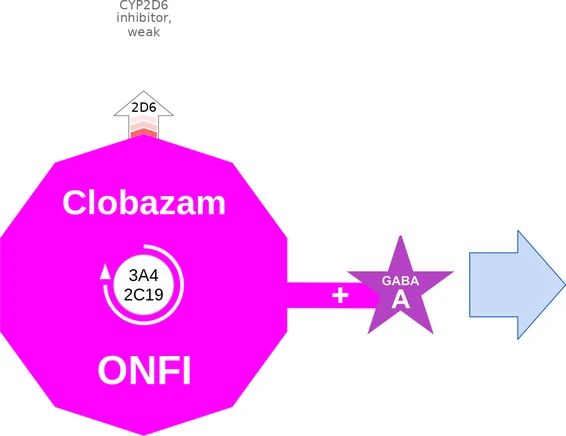
Mechanism of action: Clobazam ballicule
Open Clobazam in the interactive console ↗
Memory aids: mascots and interaction avatars

pronounced “ON-fee”
hot pink → benzo theme