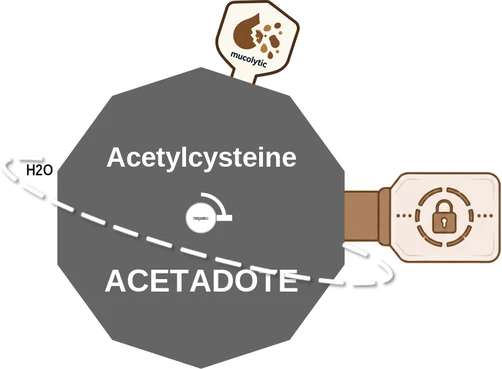
Acetylcysteine
ACETADOTE
What it isGlutathione-repleting antidote and disulfide-breaking mucolytic; acetaminophen toxicity and thick airway secretions.
Why this oneIt works best early after overdose but can still benefit established hepatic injury, so delayed presentation is not a reason to withhold it.
What limits itIV use can trigger anaphylactoid reactions; inhalation can provoke bronchospasm. Nausea and sulfur odor impair completion.
FDA label
Read the full label on DailyMed ↗
| FDA dosing | Population | Start | Target | Max |
|---|---|---|---|---|
| Mucolytic — nebulization via face mask, mouthpiece, or tracheostomy | Most patients | 3-5 mL of 20% (or 6-10 mL of 10%) TID-QID | 3-5 mL of 20% (or 6-10 mL of 10%) TID-QID | 1-10 mL of 20% (or 2-20 mL of 10%) q2-6h |
| Mucolytic — direct instillation (incl. tracheostomy care) | All | 1-2 mL of 10-20% q1-4h (PRN as often as hourly) | 1-2 mL q1-4h | q1h |
| Diagnostic bronchograms (pre-procedure) | All | 1-2 mL of 20% (or 2-4 mL of 10%) x2-3 doses by nebulization or intratracheal instillation before procedure | Same | 2-3 administrations |
Renal Undefined
Hepatic Undefined
Instructions
- 20% solution may be diluted with sodium chloride or sterile water; 10% may be used undiluted
- No preservative — refrigerate opened vials, use within 96 h (inhalation only)
- Use compatible equipment (glass, plastic, aluminum, stainless steel); reacts with iron, copper, rubber; clean nebulizer after use
- Do not place directly in heated (hot-pot) nebulizer chamber; hand bulbs not recommended
- Prolonged nebulization: when 3/4 nebulized, add ~equal volume sterile water to prevent concentration
- Do not mix with incompatible drugs (e.g., tetracyclines, erythromycin lactobionate, ampicillin, amphotericin B, hydrogen peroxide)
Cautions
- Bronchospasm may occur infrequently and unpredictably, incl. in asthmatics — from adverse-reactions text; warnings section absent from fetched label
Adverse reactions
- Stomatitis
- Nausea, vomiting
- Fever
- Rhinorrhea
- Drowsiness
- Clamminess
- Chest tightness
- Bronchoconstriction/bronchospasm (infrequent, unpredictable)
- Tracheal/bronchial irritation; hemoptysis reported (causality unclear)
- Rare sensitization
Pregnancy No adequate human studies; animal reproduction studies (up to 2.6x human dose) showed no harm — use only if clearly needed
Lactation Undefined
NO BOXED WARNINGS
Classes and tags
Clinical profile
Mechanism of action: Acetylcysteine ballicule