PPI
Proton pump inhibitor
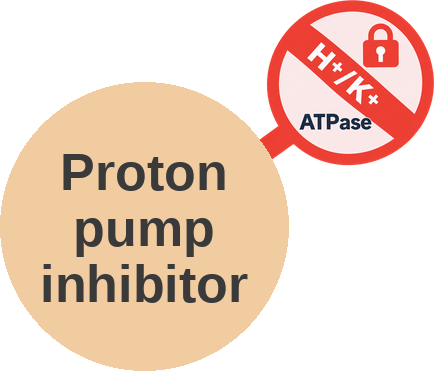
- Irreversibly blocks the gastric H⁺/K⁺-ATPase → profound acid suppression
- Heals ulcers and erosive esophagitis
- New pumps must be made to recover
- Raised pH reduces absorption of acid-dependent drugs
- Long-term B12/magnesium concerns
- Long-term fracture risk
Drugs with this mechanism (6)
- Dexlansoprazole — Dual-release proton-pump inhibitor.
- Esomeprazole — Omeprazole S-isomer; widely marketed proton-pump inhibitor.
- Lansoprazole — PPI with an orally disintegrating option; useful for swallowing difficulty or tube delivery.
- Omeprazole — OTC proton-pump inhibitor; clinically important CYP2C19 inhibition distinguishes it.
- Pantoprazole — A proton-pump inhibitor with few drug interactions; IV available.
- Rabeprazole — PPI least dependent on CYP2C19; genotype and inhibitor effects are comparatively small.
Self-check
- What is needed to recover acid secretion after irreversible pump inhibition?
New pumps must be made. - How does raised gastric pH affect acid-dependent drugs?
Reduces their absorption.
All mechanisms · Open Proton pump inhibitor (PPI) in the interactive console ↗