JAK inhibitors
Janus kinase (JAK) inhibitors
Four kinases that work in pairs
JAK–STAT in one slide
- Cytokine receptors have no enzyme of their own: a Janus kinase rides on each receptor chain, and ligand binding brings two together so they phosphorylate each other, the receptor, and then STATs, which carry the signal to the nucleus [1][6]
- The family is JAK1, JAK2, JAK3 and TYK2, and each receptor uses a fixed pair — so which JAK a drug blocks decides which cytokines go quiet [1]
- Most of these labels add the same caveat: the relevance of inhibiting a specific JAK to the therapeutic effect is not known [6]
Which pair carries which signal
The map that predicts benefit and harm
- JAK1 + JAK3 — the γ-common-chain cytokines IL-2, IL-4, IL-7, IL-9, IL-15, IL-21: lymphocyte development and function [1]
- JAK2 + JAK2 — EPO, TPO and growth hormone, plus IL-3, IL-5 and GM-CSF: red cells, platelets, myeloid growth [1]
- JAK1 + TYK2 — type I interferons; JAK2 + TYK2 — IL-12 and IL-23; JAK1 with partners — IL-6 [1]
- Read the map backwards for the harms: blocking JAK2 costs hemoglobin and platelets, blocking JAK3 costs lymphocytes [1]
JAK1 — the inflammation isoform
Rheumatology, dermatology, IBD
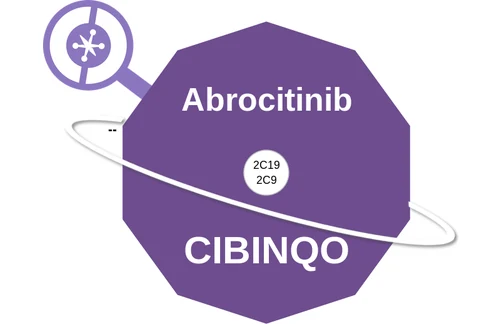
- Abrocitinib reversibly blocks the ATP site of JAK1: 28-fold over JAK2, more than 340-fold over JAK3, 43-fold over TYK2 [6]
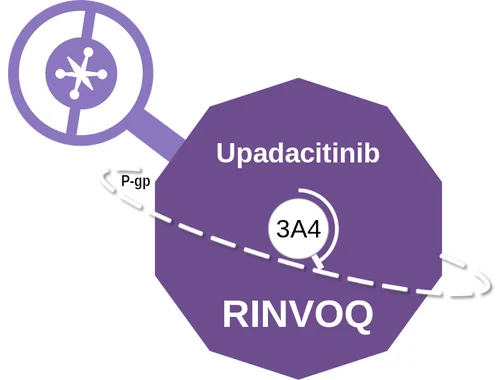
- Upadacitinib: enzyme assays favor JAK1 and JAK2 over JAK3 and TYK2, but in leukocytes it blocks JAK1 and JAK1/JAK3 signals more potently than JAK2/JAK2 — the cell result is why it carries only the JAK1 peg [6]
- Baricitinib: greater potency at JAK1, JAK2 and TYK2 than at JAK3 — so it carries JAK1 and JAK2 pegs [6]
- Labeled uses across the class: rheumatoid and psoriatic arthritis, ankylosing spondylitis, ulcerative colitis, Crohn disease, atopic dermatitis, alopecia areata [6]
JAK2 — the marrow isoform
Myeloproliferative neoplasms
- The activating JAK2 V617F mutation is present in almost all patients with polycythemia vera and in many with the related myeloproliferative neoplasms [1]
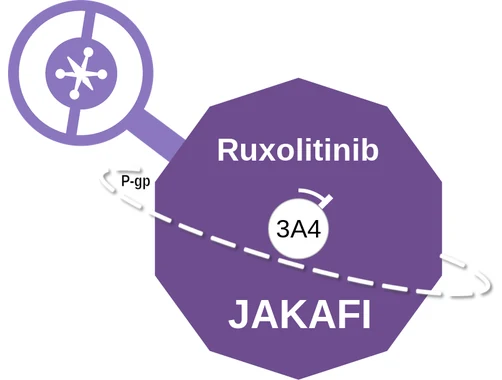
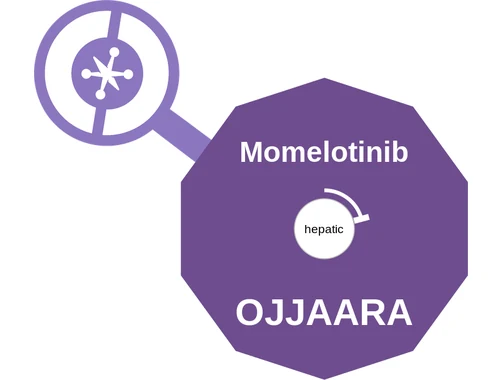
- Ruxolitinib inhibits JAK1 and JAK2; momelotinib inhibits JAK1/JAK2 and mutant JAK2V617F — both carry JAK1 and JAK2 pegs [6]
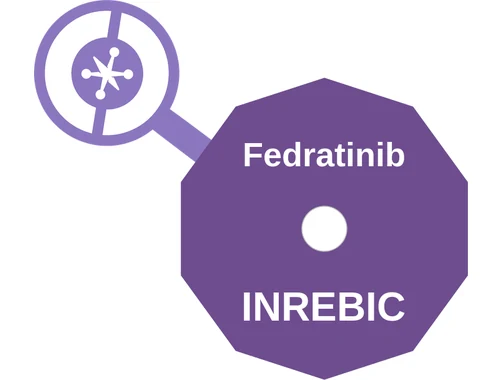
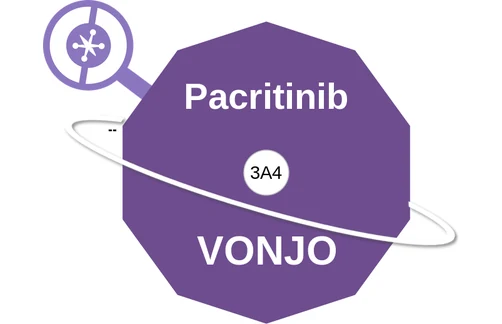
- Fedratinib inhibits JAK2 and FLT3; pacritinib inhibits JAK2 and FLT3 and does not inhibit JAK1 at clinically relevant concentrations — JAK2 peg only [6]
- Momelotinib also inhibits ACVR1 (ALK2) → ↓ hepatic hepcidin → more iron available for red-cell production: the drug for myelofibrosis with anemia [6]
- Fedratinib carries a boxed warning for encephalopathy, including Wernicke’s [6]
JAK3 — the lymphocyte isoform
γ-common-chain signaling
- JAK3 is made only in hematopoietic and lymphoid cells [2] and pairs with JAK1 on the γ-common-chain receptors; inherited JAK3 mutations cause severe combined immunodeficiency [1]
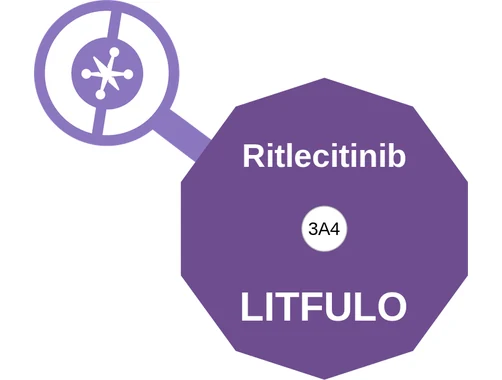
- Ritlecitinib irreversibly inhibits JAK3 and the TEC kinase family by blocking the ATP binding site [6]
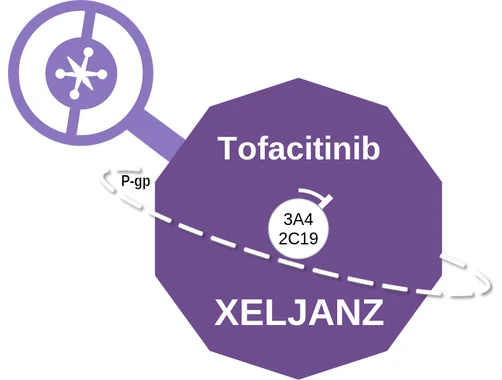
- Tofacitinib: IC50 56 nM at JAK1/JAK3, 406 nM at JAK1/JAK2, 1,377 nM at JAK2/JAK2 — JAK1 and JAK3 pegs [6]
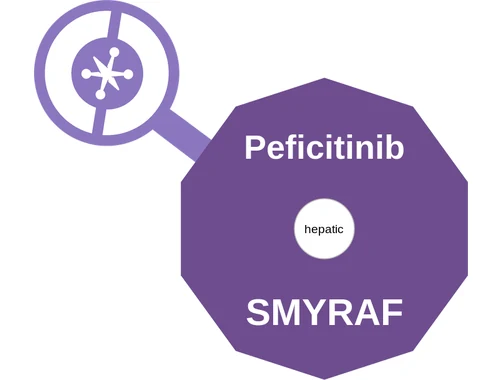
- Peficitinib (SMYRAF; approved in Japan, not in the US) is pan-JAK with moderate selectivity for JAK3 — JAK1, JAK2 and JAK3 pegs [5]
TYK2 — the allosteric exception
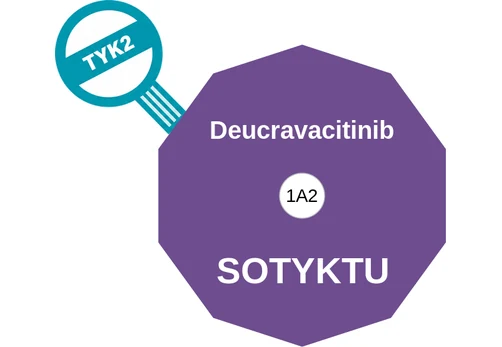
Deucravacitinib
- TYK2 pairs with JAK1 for type I interferons and with JAK2 for IL-12 and IL-23 [1][6]
- Deucravacitinib binds the regulatory domain of TYK2, not the catalytic site, holding the kinase in an inhibited conformation [6]
- Its label does not carry the JAK class boxed warning [6]
The class boxed warning
One trial, extended to the class
- ORAL Surveillance randomized patients with rheumatoid arthritis and at least one cardiovascular risk factor (mean age 61) to tofacitinib or a TNF blocker: MACE HR 1.33 (95% CI 0.91–1.94), cancer HR 1.48 (95% CI 1.04–2.09) [3]
- On 1 Sep 2021 FDA required boxed warnings for serious heart-related events, cancer, blood clots and death on XELJANZ, OLUMIANT and RINVOQ — the latter two because they share the mechanism, without trials of their own [4]
- In this library the warning (serious infections, mortality, malignancy, MACE, thrombosis) sits on tofacitinib, baricitinib, upadacitinib, abrocitinib and ritlecitinib [6]
- Ruxolitinib and fedratinib were left out because they are not indicated for arthritis or other inflammatory conditions [4]; pacritinib and momelotinib carry no boxed warning [6]
- Selectivity is not an exemption: the warning follows the indication, not the isoform [4]
References
Numbered as cited on the slides
- [1] O'Shea JJ, Schwartz DM, Villarino AV, et al. The JAK-STAT pathway: impact on human disease and therapeutic intervention. Annu Rev Med 2015;66:311–328
- [2] Kwon S. Molecular dissection of Janus kinases as drug targets for inflammatory diseases. Front Immunol 2022;13:1075192
- [3] Ytterberg SR, Bhatt DL, Mikuls TR, et al. Cardiovascular and cancer risk with tofacitinib in rheumatoid arthritis. N Engl J Med 2022;386:316–326 (ORAL Surveillance)
- [4] US FDA Drug Safety Communication, 1 Sep 2021: FDA requires warnings about increased risk of serious heart-related events, cancer, blood clots, and death for JAK inhibitors that treat certain chronic inflammatory conditions
- [5] Hamaguchi H, et al. Discovery and structural characterization of peficitinib (ASP015K) as a novel and potent JAK inhibitor. Bioorg Med Chem 2018;26:4971–4983
- [6] Prescribing information, section 12.1 and boxed warning: XELJANZ, OLUMIANT, RINVOQ, CIBINQO, LITFULO, JAKAFI, INREBIC, VONJO, OJJAARA, SOTYKTU
This is a class, not a peg. Each drug carries a JAK1, JAK2 or JAK3 peg (TYK2 for deucravacitinib) for every isoform its label names; this presentation compares them.