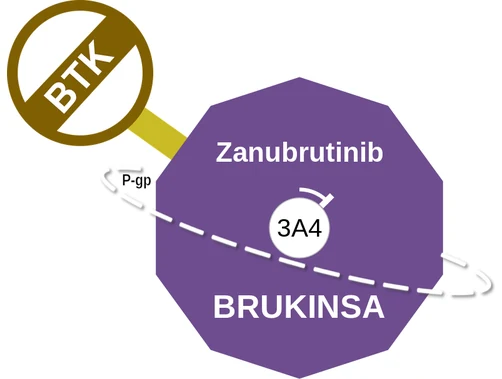
Zanubrutinib
BRUKINSA
What it isSecond-generation BTK inhibitor; CLL, mantle cell lymphoma and Waldenstrom disease.
Why this oneMore selective than ibrutinib with less atrial fibrillation, and superior progression-free survival head to head.
What limits itNeutropenia and bleeding. CYP3A4-dependent.
FDA-approved for
- mantle cell lymphoma (2019)
- CLL, Waldenstrom macroglobulinemia
FDA label
Read the full label on DailyMed ↗
| FDA dosing | Population | Start | Target | Max |
|---|---|---|---|---|
| B-cell malignancies (MCL, WM, MZL, CLL/SLL, FL) — monotherapy or with obinutuzumab | adult | 160 mg BID or 320 mg QD | 160 mg BID or 320 mg QD | 160 mg BID or 320 mg QD |
Renal No adjustment needed (CLcr ≥15 mL/min); monitor if on dialysis
Hepatic Severe (Child-Pugh C): 80 mg BID; mild-moderate: no adjustment
Instructions
- Take with or without food
- Swallow capsules whole with water; do not open, break, or chew
- Swallow tablets whole; do not chew or crush (tablets may be split in half as prescribed)
- Missed dose: take same day, resume normal schedule next day
Cautions
- Hemorrhage (including fatal/intracranial/GI)
- Infections (including opportunistic; HBV reactivation)
- Cytopenias (neutropenia, thrombocytopenia, anemia) — monitor CBC
- Second primary malignancies (skin and non-skin) — use sun protection
- Cardiac arrhythmias (atrial fibrillation/flutter)
- Hepatotoxicity, including drug-induced liver injury
- Embryo-fetal toxicity
Adverse reactions
- Decreased neutrophil count
- Decreased platelet count
- Upper respiratory tract infection
- Hemorrhage
- Musculoskeletal pain
Pregnancy Can cause fetal harm; avoid pregnancy during and 1 week after last dose
Lactation Do not breastfeed during and for 2 weeks after last dose
NO BOXED WARNINGS
Principal riskNeutropenia and bleeding
Cost, est. cash$5,000–$30,000+/month or cycle
Generic entry2043 est.
Classes and tags
Clinical profile
Legacy pregnancy categoryNot assigned — PLLR-era drug
Defining liabilityMyelosuppression and agent-specific hepatic, cardiac, pulmonary, neurologic or reproductive toxicity require oncology monitoring.
Mechanism of action: Zanubrutinib ballicule