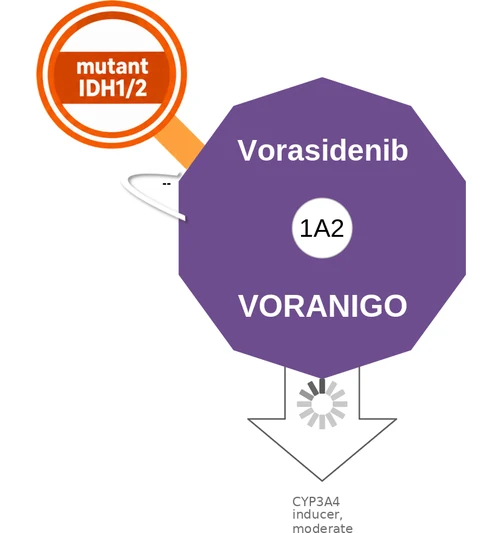
Vorasidenib
VORANIGO
What it isAn oral, brain-penetrant dual inhibitor of mutant IDH1 and IDH2 for grade 2 IDH-mutant glioma after surgery.
Why this oneIt delays progression and pushes back the date radiation and chemotherapy become necessary — a first for low-grade glioma pharmacotherapy.
What limits itHepatotoxicity requires serial liver tests; CYP1A2 inhibitors raise exposure, while smoking can lower it.
FDA label
Read the full label on DailyMed ↗
| FDA dosing | Population | Start | Target | Max |
|---|---|---|---|---|
| Grade 2 IDH1- or IDH2-mutant astrocytoma or oligodendroglioma | Adults | 40 mg QD | 40 mg QD until progression or unacceptable toxicity | 40 mg QD |
| Grade 2 IDH1- or IDH2-mutant astrocytoma or oligodendroglioma | Peds >=12 y, >=40 kg | 40 mg QD | 40 mg QD until progression or unacceptable toxicity | 40 mg QD |
| Grade 2 IDH1- or IDH2-mutant astrocytoma or oligodendroglioma | Peds >=12 y, <40 kg | 20 mg QD | 20 mg QD until progression or unacceptable toxicity | 20 mg QD |
Renal CLcr >40 mL/min: no adjustment; CLcr <=40 mL/min or dialysis: not studied — monitor for increased adverse reactions and modify dose per adverse-reaction tables
Hepatic Mild-moderate (Child-Pugh A/B): no adjustment; severe (Child-Pugh C): not studied — monitor for increased adverse reactions and modify dose per adverse-reaction tables
Instructions
- Select patients by presence of IDH1 or IDH2 mutation in tumor specimens
- Evaluate blood chemistry and liver laboratory tests before initiating
- Swallow tablets whole with water, with or without food; do not split, crush, or chew
- Take at about the same time each day; missed dose: take within 6 h, otherwise skip; if vomiting after a dose, do not replace — take next scheduled dose next day
- Adverse-reaction dose reductions: 40 mg QD -> 20 -> 10 (adults and peds >=40 kg); 20 -> 10 (peds <40 kg); permanently discontinue if unable to tolerate 10 mg QD
- Hepatotoxicity: withhold/reduce/permanently discontinue per label grade tables (ALT/AST x ULN with or without bilirubin >2x ULN)
Cautions
- Hepatotoxicity: transaminase elevations can lead to hepatic failure, hepatic necrosis, autoimmune hepatitis; monitor LFTs (AST, ALT, GGT, bilirubin, ALP) before start, q2wk for first 2 months, then monthly for first 2 years, and as indicated
- Embryo-fetal toxicity: can cause fetal harm; verify pregnancy status before starting
- Can render some hormonal contraceptives ineffective — females use effective nonhormonal contraception during treatment and 3 months after; males with partners of reproductive potential use contraception during and 3 months after
- May impair fertility in females and males (not reversible in rats)
Adverse reactions
- Fatigue (33%), headache (28%), COVID-19 (28%), musculoskeletal pain (24%), diarrhea (21%), nausea (20%), seizure (16%)
- Grade 3/4 labs (>=2%): increased ALT (9%), increased AST (4.8%), increased GGT (2.2%), decreased neutrophils (2.2%)
- Most common serious adverse reaction: seizure (3%)
Pregnancy Can cause fetal harm (animal embryo-fetal toxicity at >=8x human exposure); no human data; verify pregnancy status before starting; advise of fetal risk
Lactation Do not breastfeed during treatment and for 2 months after last dose (no human milk data; potential for adverse reactions in breastfed child)
NO BOXED WARNINGS
Classes and tags
Clinical profile
Mechanism of action: Vorasidenib ballicule