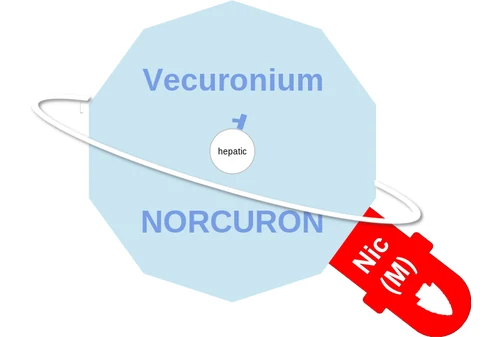
Vecuronium
NORCURON
What it isIntermediate-acting muscle nicotinic-receptor antagonist; surgical paralysis.
Why this oneMinimal autonomic and histamine effects make it more hemodynamically neutral than pancuronium or atracurium.
What limits itHepatic impairment and an active metabolite can prolong blockade. Paralysis provides no sedation or analgesia.
FDA-approved for
- neuromuscular blockade (surgery) (1984)
FDA label
Read the full label on DailyMed ↗
| FDA dosing | Population | Start | Target | Max |
|---|---|---|---|---|
| Neuromuscular blockade (intubation and surgical relaxation, adjunct to anesthesia) | Adults | 0.08–0.1 mg/kg IV bolus | Maintenance 0.01–0.015 mg/kg (first at ~25–40 min) |
Renal Undefined
Hepatic Undefined
Maintenance doses generally required within 25–40 min of the initial dose.
Instructions
- Intravenous use only; administered by/under supervision of clinicians experienced with neuromuscular blocking agents
- Monitor muscle twitch response with peripheral nerve stimulation
- Reduce initial dose with potent inhalation anesthetics (~15%) or prior succinylcholine
Cautions
- Prolonged/profound paralysis and respiratory insufficiency or apnea
- Anaphylactic/anaphylactoid reactions (life-threatening, fatal)
- Prolonged paralysis, muscle weakness, and atrophy with long-term ICU use
Adverse reactions
- Prolonged skeletal muscle weakness/paralysis
- Muscle atrophy (long-term use)
- Hypersensitivity reactions (bronchospasm, hypotension, tachycardia, urticaria/erythema)
Pregnancy Undefined
Lactation Undefined
NO BOXED WARNINGS
Principal riskNo sedation whatever — a recurring wrong-drug fatality
Classes and tags
Clinical profile
Mechanism of action: Vecuronium ballicule