Tucatinib
TUKYSA
What it isHER2-selective tyrosine-kinase inhibitor; HER2-positive metastatic breast cancer, including brain metastases.
Why this oneHER2 selectivity spares EGFR, reducing the rash and diarrhea of less selective agents while preserving CNS activity.
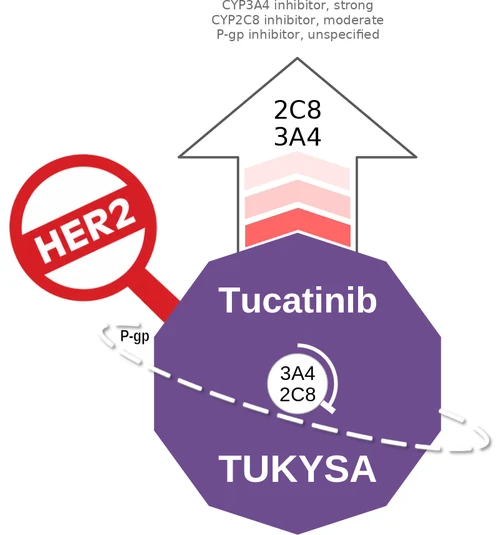
What limits itDiarrhea and hepatotoxicity require monitoring. Strong CYP2C8 inhibitors raise exposure, and tucatinib strongly inhibits CYP3A4.
FDA-approved for
- HER2-positive metastatic breast cancer (2020)
FDA label
Read the full label on DailyMed ↗
| FDA dosing | Population | Start | Target | Max |
|---|---|---|---|---|
| HER2+ metastatic breast cancer (with trastuzumab + capecitabine) | Adults | 300 mg BID | 300 mg BID | 300 mg BID |
| RAS wild-type, HER2+ unresectable/metastatic colorectal cancer (with trastuzumab) | Adults | 300 mg BID | 300 mg BID | 300 mg BID |
Renal No adjustment for mild–moderate (CLcr 30–89). With capecitabine: not recommended in severe (CLcr <30), as capecitabine is contraindicated
Hepatic Severe (Child-Pugh C): reduce to 200 mg BID. Mild–moderate: no adjustment
Instructions
- Swallow tablets whole; do not chew, crush, or split
- Do not take a broken/cracked tablet
- Take ~12 h apart at the same time each day, with or without food
- If a dose is missed or vomited, take the next dose at its usual time (do not replace)
- Confirm HER2 overexpression and RAS wild-type before colorectal use
Cautions
- Severe diarrhea (dehydration, acute kidney injury, death) — give antidiarrheals; interrupt/reduce/discontinue by severity
- Hepatotoxicity — monitor ALT/AST/bilirubin at baseline, every 3 weeks, and as indicated
- Embryo-fetal toxicity — advise contraception
Adverse reactions
- Diarrhea
- Palmar-plantar erythrodysesthesia
- Nausea, vomiting, stomatitis
- Hepatotoxicity (transaminase/bilirubin increases)
- Decreased appetite
- Anemia
- Rash
- Increased serum creatinine (tubular; benign)
Pregnancy Can cause fetal harm (animal embryo-fetal mortality, reduced weight, malformations); advise contraception
Lactation Do not breastfeed during treatment and for 1 week after last dose
NO BOXED WARNINGS
Principal riskDiarrhea and hepatotoxicity
Cost, est. cash$5,000–$30,000+/month or cycle
Generic entry2038 est.
Classes and tags
Clinical profile
Legacy pregnancy categoryNot assigned — PLLR-era drug
Defining liabilityMyelosuppression and agent-specific hepatic, cardiac, pulmonary, neurologic or reproductive toxicity require oncology monitoring.
Mechanism of action: Tucatinib ballicule