Bactrim
Combination product
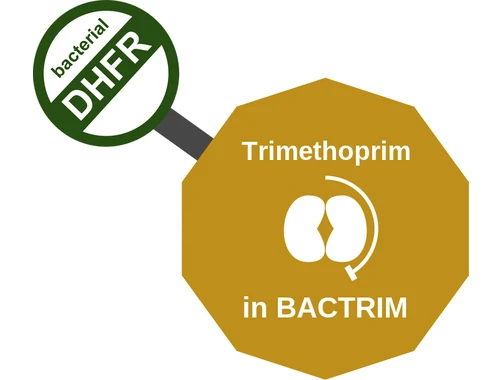
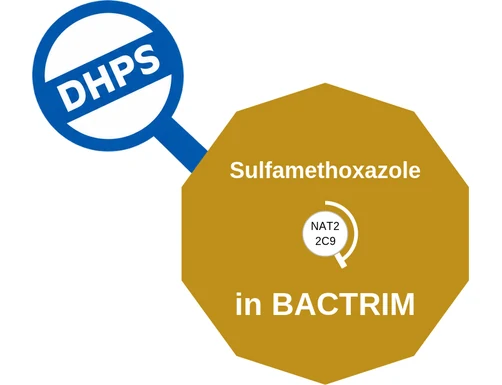
What it isSequential folate-pathway blocker (sulfonamide plus trimethoprim); cystitis, purulent MRSA skin infection, Pneumocystis.
Why this oneRegimen of choice for purulent community MRSA skin infection; first-line cystitis where resistance is under 20%.
What limits itNo reliable strep coverage, so add a beta-lactam for cellulitis; rash, SJS, cytopenias and hyperkalemia.
Pearls
- Contraindicated at term: kernicterus and neonatal G6PD hemolysis
- Hyperkalemia worse with ACEi/ARB, spironolactone or CKD
- Acne: reserve for failure of other oral antibiotics
- Adding to cephalexin does not improve uncomplicated cellulitis

Back trim: “Sulfa mask + Trim & prim”
Components (2)
FDA label
Read the full label on DailyMed ↗
| FDA dosing | Population | Start | Target | Max |
|---|---|---|---|---|
| Urinary tract infection | Adults | 800/160 mg q12h x 10-14 days (1 DS tablet or 2 single-strength tablets) | 800/160 mg q12h | 800/160 mg q12h (1 DS BID) |
| Shigellosis | Adults | 800/160 mg q12h x 5 days (1 DS tablet or 2 single-strength tablets) | 800/160 mg q12h | 800/160 mg q12h (1 DS BID) |
| UTI / acute otitis media | >=2 mo | 40 mg/kg SMX + 8 mg/kg TMP per 24 h, divided q12h x 10 days | same | Per weight table q12h: 10 kg 200/40 mg (1/2 tab), 20 kg 400/80 mg (1 tab), 30 kg 600/120 mg (1 1/2 tabs), 40 kg 800/160 mg (2 tabs or 1 DS) |
| Shigellosis | >=2 mo | 40 mg/kg SMX + 8 mg/kg TMP per 24 h, divided q12h x 5 days | same | Per weight table q12h, up to 800/160 mg (2 tabs or 1 DS) at 40 kg |
| Acute exacerbation of chronic bronchitis | Adults | 800/160 mg q12h x 14 days (1 DS tablet or 2 single-strength tablets) | 800/160 mg q12h | 800/160 mg q12h (1 DS BID) |
| Pneumocystis jirovecii pneumonia, treatment | Adults & peds | 75-100 mg/kg SMX + 15-20 mg/kg TMP per 24 h, divided q6h x 14-21 days | same | Upper-limit weight table q6h, to 5 tabs or 2 1/2 DS q6h at 80 kg; give 75% of table dose for the lower-limit (75/15 mg/kg/day) regimen |
| P. jirovecii pneumonia, prophylaxis | Adults | 800/160 mg QD (1 DS tablet) | same | 800/160 mg QD |
| P. jirovecii pneumonia, prophylaxis | Children | 750 mg/m2/day SMX + 150 mg/m2/day TMP, divided BID, on 3 consecutive days per week | same | 1600 mg SMX / 320 mg TMP per day; label guideline table (q12h, single-strength tablets): BSA 0.26 m2 – (no tablet dose); 0.53 m2 ½ tab; 1.06 m2 1 tab |
| Traveler's diarrhea | Adults | 800/160 mg q12h x 5 days (1 DS tablet or 2 single-strength tablets) | 800/160 mg q12h | 800/160 mg q12h (1 DS BID) |
Renal CrCl >30: usual regimen. CrCl 15–30: half the usual regimen. CrCl <15: use not recommended.
Hepatic Contraindicated in marked hepatic damage.
Available strengths
- tab 80/400, 160/800 mg
- susp 40/200 mg/5 mL
- inj 16/80 mg/mL
Contraindications
- History of drug-induced immune thrombocytopenia with trimethoprim and/or sulfonamides
- Documented megaloblastic anemia due to folate deficiency
- Pediatric patients less than 2 months of age
- Marked hepatic damage
- Severe renal insufficiency when renal function cannot be monitored
- Concomitant dofetilide
Cautions
- Embryofetal toxicity - epidemiologic studies suggest increased congenital malformations (neural tube, cardiovascular, urinary tract, oral clefts, club foot)
- Fatal and serious hypersensitivity reactions: severe cutaneous adverse reactions (SJS, TEN, DRESS, AFND, AGEP), fulminant hepatic necrosis, agranulocytosis/aplastic anemia and other blood dyscrasias, acute and delayed lung injury, anaphylaxis, circulatory shock
- Discontinue at the first appearance of skin rash or any sign of serious reaction; rash, pharyngitis, fever, arthralgia, cough, chest pain, dyspnea, pallor, purpura or jaundice may be early signs
- Respiratory hypersensitivity (cough, dyspnea, pulmonary infiltrates) and severe pulmonary reactions causing prolonged respiratory failure, ECMO, lung transplant or death
- Circulatory shock with fever, severe hypotension and confusion within minutes to hours of re-challenge after recent exposure
- Hemophagocytic lymphohistiocytosis - discontinue immediately if suspected
- Immune-mediated thrombocytopenia, sometimes fatal or life-threatening
- Do not use for group A beta-hemolytic streptococcal infections - will not prevent rheumatic fever
- Clostridioides difficile-associated diarrhea, from mild diarrhea to fatal colitis, may occur up to 2 months after therapy
- Avoid co-administration with leucovorin when treating P. jirovecii pneumonia (treatment failure and excess mortality)
- Avoid in impaired renal or hepatic function, possible folate deficiency (elderly, chronic alcoholics, anticonvulsant therapy, malabsorption, malnutrition) and in severe allergy or bronchial asthma
- Hemolysis in G6PD deficiency (frequently dose-related)
- Rare hypoglycemia in non-diabetic patients - highest risk with renal dysfunction, liver disease, malnutrition or high doses
- Can precipitate porphyria crisis and hypothyroidism - avoid in porphyria or thyroid dysfunction
- Increased adverse reactions (rash, fever, leukopenia, transaminase elevation) in AIDS patients treated for P. jirovecii pneumonia
- Hyperkalemia (high-dose trimethoprim, renal insufficiency, potassium-metabolism disorders) and severe symptomatic hyponatremia - monitor serum potassium and sodium
- Maintain adequate fluid intake and urine output to prevent crystalluria and stone formation
- Monitor CBC and clinical chemistry frequently; discontinue for significant electrolyte abnormality, renal insufficiency, or a fall in any formed blood element
Adverse reactions
- Most common: GI disturbances (nausea, vomiting, anorexia) and allergic skin reactions (rash, urticaria)
- Serious: SCARs (SJS/TEN/DRESS), blood dyscrasias, hepatitis/hepatic necrosis, renal failure/interstitial nephritis, aseptic meningitis, hyperkalemia
Pregnancy Use during pregnancy only if potential benefit justifies fetal risk (interferes with folic acid metabolism); some retrospective studies associate first-trimester exposure with congenital malformations - neural tube defects, cardiovascular abnormalities, urinary tract defects, oral clefts and club foot
Lactation Levels in breast milk are about 2-5% of the recommended daily infant dose (infants >2 months); use caution in nursing women, especially with jaundiced, ill, stressed or premature infants (bilirubin displacement and kernicterus risk)
Cost
Clinical profile
Defining liabilitySevere skin reactions, marrow toxicity and hyperkalemia
Part D rank #127.
Self-check
- Which two antibiotics are combined in Bactrim?
Trimethoprim and sulfamethoxazole. - Does the supplied Bactrim indication include PJP prophylaxis as well as treatment?
Yes.