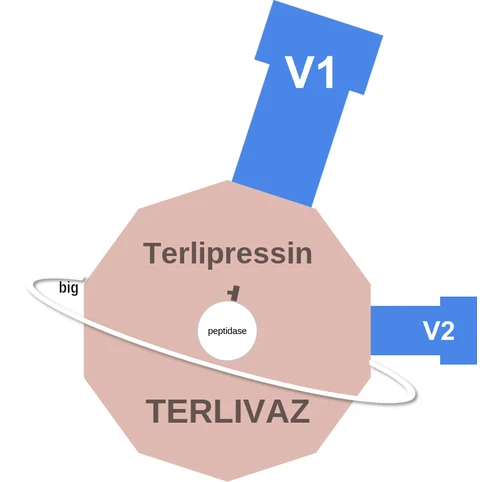
Terlipressin
TERLIVAZ
What it isV1- and V2-receptor agonist producing splanchnic vasoconstriction; hepatorenal syndrome.
Why this oneIt is the first targeted vasoconstrictor approved to reverse hepatorenal syndrome with rapid kidney decline.
What limits itSerious or fatal respiratory failure and ischemia require oxygenation screening; avoid in hypoxia and monitor sodium.
FDA-approved for
- hepatorenal syndrome (2022)
FDA label
Read the full label on DailyMed ↗
| FDA dosing | Population | Start | Target | Max |
|---|---|---|---|---|
| Hepatorenal syndrome with rapid reduction in kidney function | Adults | 0.85 mg (1 vial) IV q6h (Days 1–3) | 0.85 mg q6h; may increase to 1.7 mg (2 vials) q6h on Day 4 if SCr decreased <30% from baseline | 1.7 mg (2 vials) IV q6h |
Renal Undefined
Hepatic No adjustment needed
Day 4: adjust dose by change in SCr from baseline; discontinue if SCr at/above baseline; continue until 24h after two consecutive SCr ≤1.5 mg/dL, max 14 days
Instructions
- Reconstitute each vial with 5 mL 0.9% Sodium Chloride (0.85 mg/5 mL)
- Give by slow IV bolus over 2 minutes via peripheral or central line; flush line after
- Obtain baseline SpO2 and assess ACLF grade/volume status before first dose; monitor continuous pulse oximetry
- Do not initiate in hypoxic patients (e.g., SpO2 <90%) until oxygenation improves; avoid in ACLF Grade 3
Contraindications
- Hypoxia or worsening respiratory symptoms
- Ongoing coronary, peripheral, or mesenteric ischemia
Cautions
- Serious or fatal respiratory failure — manage volume overload
- Adverse reactions may make patient ineligible for liver transplant (esp. MELD ≥35)
- Vasoconstrictor — cardiac, cerebrovascular, peripheral, or mesenteric ischemia
- Embryo-fetal toxicity — induces uterine contractions and endometrial ischemia
Adverse reactions
- Abdominal pain
- Nausea
- Respiratory failure
- Diarrhea
- Dyspnea
- Fluid overload
Pregnancy May cause fetal harm; induces uterine contractions and endometrial ischemia
Lactation No data on presence in milk; weigh clinical need against risk
⚠ BOXED WARNING
- Serious or fatal respiratory failure
Classes and tags
Clinical profile
Mechanism of action: Terlipressin ballicule