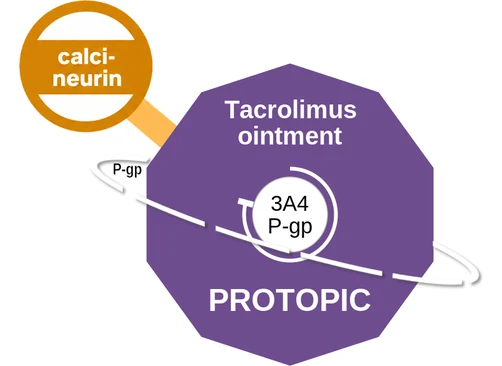
Tacrolimus ointment
PROTOPIC
What it isTopical calcineurin inhibitor that suppresses T-cell inflammation; moderate to severe atopic dermatitis.
Why this oneMore potent than pimecrolimus, it is the stronger steroid-sparing choice for face, eyelids, and folds.
What limits itBurning often ends the trial; avoid active infection and excessive UV exposure, and discuss the boxed malignancy warning.
FDA label
Read the full label on DailyMed ↗
| FDA dosing | Population | Start | Target | Max |
|---|---|---|---|---|
| Moderate to severe atopic dermatitis (second-line, short-term/intermittent) | Adults (0.03% or 0.1%) | Apply thin layer BID | Thin layer BID to affected skin | Apply BID |
| Moderate to severe atopic dermatitis (second-line, short-term/intermittent) | Children 2-15 y (0.03% only) | Apply thin layer BID | Thin layer BID to affected skin | Apply BID |
Renal No adjustment needed (dose adjustment not expected to be needed)
Hepatic No adjustment needed (dose adjustment not expected to be needed)
Continuous long-term use should be avoided; limit to areas of atopic dermatitis involvement
Instructions
- Apply a thin layer to affected skin twice daily; rub in gently and completely
- Stop use when signs and symptoms resolve; re-examine if no improvement within 6 weeks
- Do not use with occlusive dressings
- Minimize/avoid natural or artificial sunlight
- Avoid eyes and mouth; wash hands after application (if not treating hands)
- Not for immunocompromised patients; avoid on pre-malignant/malignant skin
Cautions
- Local skin burning, stinging, pruritus
- Bacterial and viral skin infections (resolve before treatment; risk of varicella zoster, herpes simplex, eczema herpeticum)
- Lymphadenopathy — investigate etiology
- Sun exposure — minimize/avoid
- Not studied in immunocompromised patients or generalized erythroderma
- Rare post-marketing acute renal failure; caution in patients predisposed to renal impairment
Adverse reactions
- Skin burning
- Pruritus
- Flu-like symptoms
- Skin erythema
- Headache
- Skin infection
Pregnancy Pregnancy Category C — use only if potential benefit justifies potential risk to the fetus
Lactation Tacrolimus excreted in human milk; decide whether to discontinue nursing or drug
NO BOXED WARNINGS
Classes and tags
Clinical profile
Mechanism of action: Tacrolimus ointment ballicule