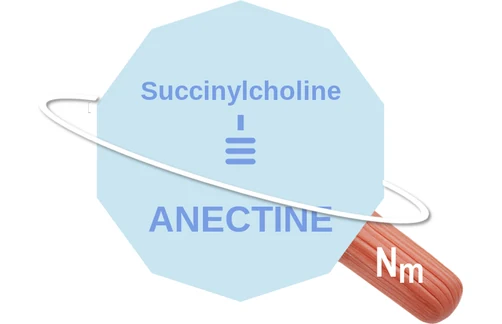
Succinylcholine
ANECTINE
What it isDepolarizing nicotinic agonist at the neuromuscular junction; rapid-sequence intubation.
Why this oneOnset within a minute and offset within ten, which no nondepolarizing agent matches.
What limits it⚑ Hyperkalemic arrest follows burns, crush injury, denervation or prolonged immobility. It also triggers malignant hyperthermia.
FDA-approved for
- rapid-sequence intubation (1952)
FDA label
Read the full label on DailyMed ↗
| FDA dosing | Population | Start | Target | Max |
|---|---|---|---|---|
| Neuromuscular blockade / facilitate tracheal intubation (short procedures) | Adults, IV | 0.6 mg/kg IV (range 0.3-1.1 mg/kg) | titrate to effect |
Renal Undefined
Hepatic Undefined
Reserve pediatric use for emergency intubation; IV bolus in children may cause profound bradycardia/asystole.
Instructions
- For IV or IM use only.
- Do not administer before unconsciousness is induced (except emergencies).
- Pretreat with an anticholinergic (e.g., atropine) to reduce bradyarrhythmias.
- Monitor neuromuscular function with a peripheral nerve stimulator when given by infusion.
Contraindications
- Known or suspected genetic susceptibility to malignant hyperthermia
- Skeletal muscle myopathies
- After acute phase of major burns, multiple trauma, extensive denervation, or upper motor neuron injury (severe hyperkalemia risk)
Cautions
- MAOIs may diminish plasma cholinesterase activity
- Anaphylaxis
- Risk of death from medication errors (unintended paralysis)
- Hyperkalemia — serious arrhythmias/cardiac arrest
- Malignant hyperthermia
- Bradycardia (esp. with a second dose)
- Increased intraocular pressure
Adverse reactions
- Cardiac arrest, arrhythmias, bradycardia, tachycardia
- Hyper-/hypotension
- Hyperkalemia
- Malignant hyperthermia; rhabdomyolysis
- Prolonged respiratory depression/apnea
- Anaphylaxis
Pregnancy Decades of data show no drug-associated risk; risk of prolonged apnea (plasma cholinesterase decreased ~24%).
Lactation No data on presence in milk; weigh benefits/risks.
⚠ BOXED WARNING
- Risk of cardiac arrest from hyperkalemic rhabdomyolysis in children
Principal riskEndogenous or dietary; no boxed warning applies
Classes and tags
Clinical profile
Mechanism of action: Succinylcholine ballicule
Open Succinylcholine in the interactive console ↗
Memory aids: mascots and interaction avatars

baby blue theme → muscarinic