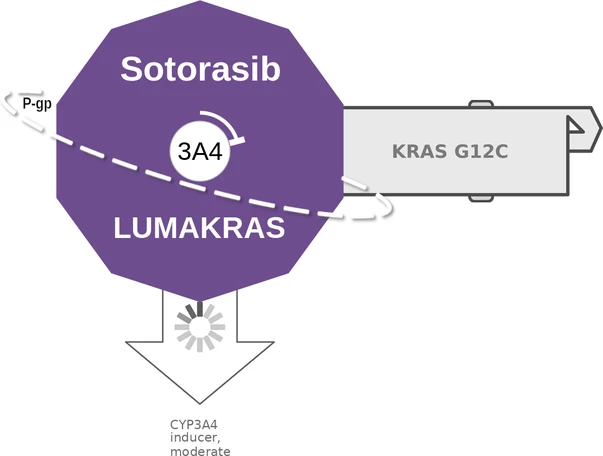
Sotorasib
LUMAKRAS
What it isCovalent KRAS G12C inhibitor; KRAS G12C-mutant non-small-cell lung cancer.
Why this oneIts pocket-binding strategy opened KRAS G12C to direct drug therapy after decades of failure.
What limits itHepatotoxicity and interstitial lung disease require monitoring; gastric acid is needed for absorption, so PPIs interfere.
FDA-approved for
- KRAS G12C-mutated non-small cell lung cancer (2021)
FDA label
Read the full label on DailyMed ↗
| FDA dosing | Population | Start | Target | Max |
|---|---|---|---|---|
| KRAS G12C-mutated NSCLC (single agent) | Adults | 960 mg QD | 960 mg QD | 960 mg QD |
| KRAS G12C-mutated mCRC (with panitumumab) | Adults | 960 mg QD | 960 mg QD | 960 mg QD |
Renal Undefined
Hepatic Undefined
For mCRC, administer the first LUMAKRAS dose before the first panitumumab infusion
Instructions
- Swallow tablets whole with or without food; do not chew, crush, or split
- If unable to swallow solids, disperse tablets in 120 mL room-temperature water and drink immediately or within 2 hours
- Take at the same time each day
- If a dose is missed by more than 6 hours or vomiting occurs, take the next dose the next day
- Select patients based on KRAS G12C mutation
Cautions
- Hepatotoxicity — monitor liver function tests every 3 weeks for first 3 months, then monthly
- Interstitial lung disease / pneumonitis
Adverse reactions
- Diarrhea
- Musculoskeletal pain
- Nausea
- Fatigue
- Hepatotoxicity
- Cough (NSCLC)
- Rash, dry skin, stomatitis (with panitumumab)
- Lab abnormalities (decreased lymphocytes/hemoglobin, increased AST/ALT)
Pregnancy No human data; animal studies showed no major adverse developmental effects up to 4.6× human exposure
Lactation Do not breastfeed during treatment and for 1 week after the last dose
NO BOXED WARNINGS
Principal riskHepatotoxicity; PPIs reduce absorption
Cost, est. cash$5,000–$30,000+/month or cycle
Generic entry2040 est.
Classes and tags
Clinical profile
Legacy pregnancy categoryNot assigned — PLLR-era drug
Defining liabilityMyelosuppression and agent-specific hepatic, cardiac, pulmonary, neurologic or reproductive toxicity require oncology monitoring.
Mechanism of action: Sotorasib ballicule