Sodium zirconium cyclosilicate
LOKELMA
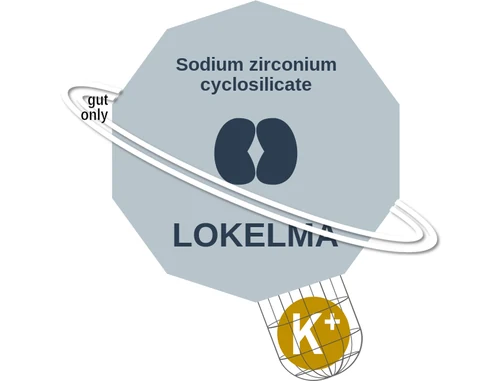
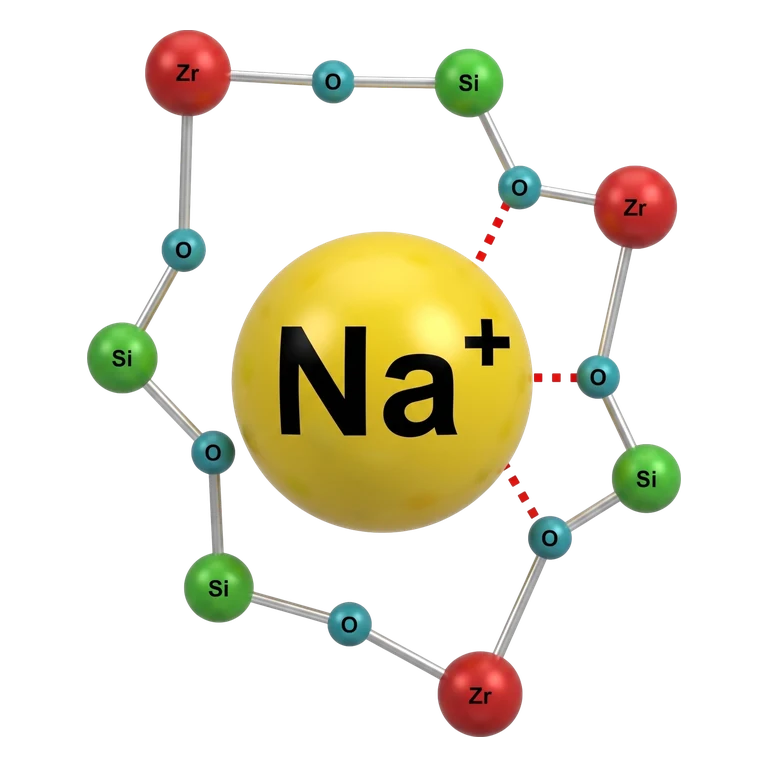
What it isNonabsorbed potassium binder exchanging sodium and hydrogen for potassium; nonemergent hyperkalemia.
Why this oneIt acts faster than older binders and can preserve RAAS therapy, but it does not replace emergency membrane stabilization or potassium shifting.
What limits itIts sodium load can worsen heart-failure edema, and other oral drugs require dosing separation.
FDA label
Read the full label on DailyMed ↗
| FDA dosing | Population | Start | Target | Max |
|---|---|---|---|---|
| Hyperkalemia — initial | Adults | 10 g TID for up to 48 hours | 10 g QD maintenance | — |
| Hyperkalemia — maintenance | Adults | 10 g QD | 5 g every other day to 15 g daily | 15 g/day |
| Hyperkalemia — chronic hemodialysis | Adults on dialysis | 5 g QD on non-dialysis days (10 g QD if serum K >6.5 mEq/L) | 5–15 g QD on non-dialysis days | 15 g/day |
Titration Adjust at intervals of 1 week or longer, in increments of 5 g
Renal Chronic hemodialysis: 5 g QD on non-dialysis days (see indications); no separate adjustment specified for non-dialysis CKD
Hepatic Undefined
Initial 10 g TID is for up to 48 hours only, then switch to once-daily maintenance
Instructions
- Administer other oral medications at least 2 hours before or after LOKELMA
- Empty packet(s) into ~3 tablespoons of water, stir well, and drink immediately; repeat until no powder remains
Cautions
- GI adverse events in motility disorders — avoid in severe constipation, bowel obstruction, or impaction
- Edema (esp. at 15 g/day)
- Hypokalemia (esp. patients on hemodialysis)
- Radio-opaque — may appear as an imaging agent on abdominal X-ray
Adverse reactions
- Mild to moderate edema
- Constipation
- Hypokalemia
Pregnancy Not absorbed systemically; fetal exposure not expected
Lactation Not absorbed systemically; exposure of the breastfed child not expected
NO BOXED WARNINGS
Principal riskSodium load worsening heart-failure edema
Cost, est. cash$5–$500/month
Generic entry2035 est.
Classes and tags
Clinical profile
Legacy pregnancy categoryNot assigned — PLLR-era drug
Defining liabilityLocal irritation, sensitization or administration-site injury; negligible systemic toxicity at usual use.
Mechanism of action: Sodium zirconium cyclosilicate ballicule
Open Sodium zirconium cyclosilicate in the interactive console ↗
Memory aids: mascots and interaction avatars
Open Sodium zirconium cyclosilicate in the interactive console ↗