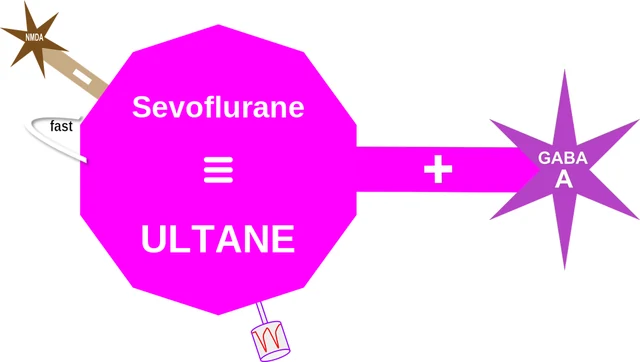
Sevoflurane
ULTANE
What it isVolatile GABA-A enhancer and NMDA antagonist; induction and maintenance of anesthesia.
Why this oneLow pungency makes it the only volatile suited to inhalational induction, so it is standard in children.
What limits itMalignant hyperthermia trigger. Compound A formation with low fresh gas flow; emergence delirium in children.
FDA-approved for
- inhalational anesthesia (1995)
FDA label
Read the full label on DailyMed ↗
| FDA dosing | Population | Start | Target | Max |
|---|---|---|---|---|
| General anesthesia — maintenance | Adults & peds | 0.5-3% inhaled, ± nitrous oxide | surgical MAC by age | |
| General anesthesia — induction | Adults & peds | mask induction, concentration titrated |
Renal Undefined
Hepatic Undefined
Instructions
- Deliver from a vaporizer calibrated specifically for sevoflurane
- Replace desiccated CO2 absorbent (exothermic reaction risk / Compound A)
- Individualize based on patient response
Contraindications
- Known or suspected genetic susceptibility to malignant hyperthermia
- Known or suspected sensitivity to sevoflurane or other halogenated inhalational anesthetics
Cautions
- Malignant hyperthermia
- Seizures (postmarketing, especially in children/young adults)
- QT prolongation / Torsade de Pointes
- Perioperative hepatic dysfunction/hepatitis
- Compound A formation with desiccated CO2 absorbents
Adverse reactions
- Nausea
- Vomiting
- Hypotension
- Agitation
- Somnolence
- Increased cough
- Bradycardia
- Laryngospasm
- Shivering
Pregnancy No adequate human data; animal reduced fetal weight; NMDA/GABA anesthetics may increase neuronal apoptosis with >3 h exposure
Lactation Undefined
NO BOXED WARNINGS
Principal riskMalignant hyperthermia trigger; emergence delirium in children
Classes and tags
Clinical profile
Mechanism of action: Sevoflurane ballicule