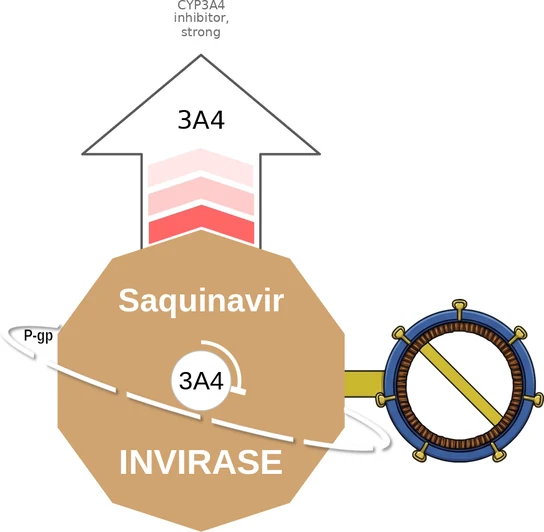
Saquinavir
INVIRASE
What it isThe first HIV protease inhibitor; HIV.
Why this oneIt proved that protease inhibition worked, which made combination antiretroviral therapy possible.
What limits itPoor bioavailability required boosting, and QT and PR prolongation limit it. Effectively obsolete.
FDA-approved for
- HIV infection (1995)
FDA label
Read the full label on DailyMed ↗
| FDA dosing | Population | Start | Target | Max |
|---|---|---|---|---|
| HIV-1 infection (with ritonavir + other antiretrovirals) | Adult >16y | 1000 mg BID | 1000 mg BID | 1000 mg BID |
Renal Undefined
Hepatic Contraindicated (with ritonavir) in severe hepatic impairment
Doses <1000 mg with ritonavir not recommended (no antiviral activity)
Instructions
- Must be used in combination with ritonavir 100 mg BID
- Take within 2 hours after a meal
- Take ritonavir at the same time as Invirase
Contraindications
- Severe hepatic impairment (when given with ritonavir)
- Concurrent rifampin (risk of severe hepatocellular toxicity)
- Concurrent CYP3A4-dependent drugs causing serious/life-threatening reactions (ergot derivatives, midazolam, triazolam, pimozide, cisapride, astemizole, terfenadine)
Cautions
- Must be used in combination with ritonavir
- Interrupt for serious/severe toxicity until etiology identified or toxicity resolves
- Do not use with lovastatin/simvastatin; caution with other CYP3A4-metabolized statins (myopathy incl. rhabdomyolysis)
- St. John's wort not recommended (loss of virologic response, resistance)
- Fluticasone with INVIRASE/ritonavir not recommended (Cushing's syndrome, adrenal suppression)
- Monitor digoxin levels; digoxin dose reduction may be needed
- New-onset/exacerbated diabetes mellitus and hyperglycemia (protease-inhibitor class)
- Worsening liver disease reported in hepatitis B/C, cirrhosis, chronic alcoholism; caution in hepatic impairment
- Hyperlipidemia — monitor cholesterol/triglycerides before and during therapy (marked triglycerides risk pancreatitis)
- Spontaneous bleeding in hemophilia A/B (protease-inhibitor class)
- Fat redistribution/accumulation; immune reconstitution syndrome
- Caution in severe renal impairment (not studied)
Adverse reactions
- Nausea
- Vomiting
- Diarrhea
- Diabetes mellitus/hyperglycemia
- Lipodystrophy
Pregnancy Undefined
Lactation Undefined
NO BOXED WARNINGS
Principal riskPoor bioavailability required boosting, and QT and PR prolongation limit it
Classes and tags
Clinical profile
Mechanism of action: Saquinavir ballicule