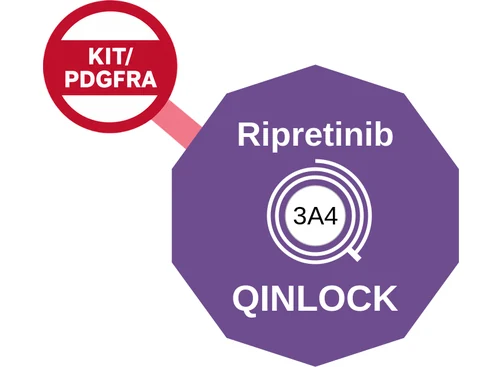
Ripretinib
QINLOCK
What it isAn oral switch-control tyrosine kinase inhibitor that broadly inhibits KIT and PDGFRA, including many secondary resistance mutations.
Why this oneIt is approved for fourth-line advanced gastrointestinal stromal tumor after progression on three or more prior kinase inhibitors including imatinib.
What limits itPalmar-plantar erythrodysesthesia, hypertension, cardiac dysfunction, and new primary cutaneous malignancies require monitoring.
FDA label
Read the full label on DailyMed ↗
| FDA dosing | Population | Start | Target | Max |
|---|---|---|---|---|
| Advanced gastrointestinal stromal tumor (GIST), previously treated (imatinib/sunitinib/regorafenib) | Adults | 150 mg QD | 150 mg QD until progression or unacceptable toxicity | 150 mg QD (150 mg BID only during unavoidable moderate CYP3A inducer co-use) |
Renal Undefined
Hepatic No dose adjustment (Child-Pugh A, B, or C)
Instructions
- Swallow tablets whole, with or without food, same time each day
- Missed dose: take if <8 h since scheduled time; if vomiting occurs, do not redose — take next scheduled dose
- Dose reduction for adverse reactions: 100 mg QD; discontinue if 100 mg QD not tolerated
- Withhold/modify for PPES, grade 3 hypertension, grade 2-3 arthralgia/myalgia, other grade 3-4 reactions per Table 1; permanently discontinue for grade 4 hypertension or grade 3-4 LV systolic dysfunction
- Avoid moderate CYP3A inducers; if unavoidable, increase to 150 mg BID, then resume 150 mg QD 14 days after inducer stops
- Withhold ≥1 wk before elective surgery; do not give for ≥2 wks after major surgery and until adequate wound healing
Cautions
- Palmar-plantar erythrodysesthesia syndrome (21%) — withhold/dose-reduce by severity
- New primary cutaneous malignancies (cuSCC, melanoma) — dermatologic evaluation at baseline and routinely
- Hypertension (14%, grade 3 7%) — do not initiate with uncontrolled hypertension; monitor BP
- Cardiac dysfunction — assess ejection fraction before and during treatment; permanently discontinue for grade 3-4 LV systolic dysfunction
- Impaired wound healing — hold around surgery
- Photosensitivity — limit direct UV exposure during and ≥1 wk after treatment
- Embryo-fetal toxicity — effective contraception (both sexes) during and 1 wk after treatment; may impair male fertility
Adverse reactions
- Alopecia
- Fatigue
- Nausea
- Abdominal pain
- Constipation
- Myalgia
- Diarrhea
- Decreased appetite
- Palmar-plantar erythrodysesthesia
- Vomiting
- Lab: increased lipase, decreased phosphate (grade 3-4 ≥4%)
Pregnancy Can cause fetal harm (animal malformations at ~half human exposure); verify pregnancy status before start; no human data
Lactation Do not breastfeed during treatment and for 1 week after last dose
NO BOXED WARNINGS
Principal riskNo FDA boxed warning.
Cost, est. cash$5,000–$30,000+/month or cycle
Generic entry2042 est.
Classes and tags
Clinical profile
Legacy pregnancy categoryNot assigned — PLLR-era drug
Defining liabilityMyelosuppression and agent-specific hepatic, cardiac, pulmonary, neurologic or reproductive toxicity require oncology monitoring.
Mechanism of action: Ripretinib ballicule