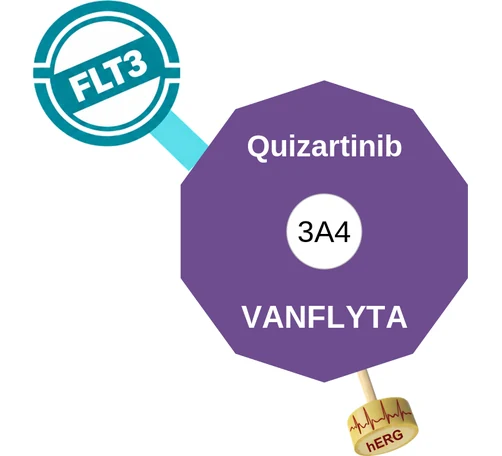
Quizartinib
VANFLYTA
What it isAn oral FLT3 inhibitor added to chemotherapy for newly diagnosed FLT3-ITD-positive AML.
Why this oneIt is highly selective for the FLT3-ITD driver, extending survival when layered onto standard induction and continued as maintenance.
What limits itQT prolongation is its signature hazard, managed under a REMS with ECG-gated dose escalation, and strong CYP3A inhibitors force dose reduction.
FDA label
Read the full label on DailyMed ↗
| FDA dosing | Population | Start | Target | Max |
|---|---|---|---|---|
| Newly diagnosed FLT3-ITD-positive AML — induction (with cytarabine + anthracycline) | Adults | 35.4 mg QD, Days 8-21 of each 28-day cycle (7+3; Days 6-19 for 5+2) | 35.4 mg QD, up to 2 cycles | 35.4 mg QD |
| Newly diagnosed FLT3-ITD-positive AML — consolidation (with high-dose cytarabine) | Adults | 35.4 mg QD, Days 6-19 of each 28-day cycle | 35.4 mg QD, up to 4 cycles | 35.4 mg QD |
| Newly diagnosed FLT3-ITD-positive AML — maintenance (monotherapy) | Adults; start after consolidation once ANC >500/mm3 and platelets >50,000/mm3 | 26.5 mg QD Days 1-14 of first cycle (if QTcF ≤450 ms) | 53 mg QD from Day 15 if QTcF ≤450 ms; keep 26.5 mg QD if QTcF >500 ms occurred during induction/consolidation | 53 mg QD, up to 36 cycles |
Titration Maintenance: increase 26.5 mg QD to 53 mg QD on Day 15 of the first cycle only if QTcF ≤450 ms
Renal No adjustment needed for mild-moderate impairment (CLcr 30-89 mL/min); severe (CLcr <30) not studied
Hepatic No adjustment needed for mild-moderate impairment (Child-Pugh A or B); severe (C) not studied
Initiate/escalate only if QTcF ≤450 ms; QTcF 481-500 ms: reduce dose; >500 ms: interrupt then resume reduced; recurrent >500 ms or torsades/life-threatening arrhythmia: permanently discontinue
Instructions
- Select patients by FDA-approved FLT3-ITD mutation test
- Swallow tablets whole; do not cut, crush, or chew
- With or without food, same time each day
- If dose vomited, do not replace; wait for next scheduled dose
- Missed dose: take same day, then resume schedule; never two doses in one day
- Stop 7 days before start of HSCT conditioning regimen
- With strong CYP3A inhibitors reduce dose: 53→26.5 mg, 35.4→17.7 mg, 26.5→17.7 mg QD (interrupt if on 17.7 mg); resume prior dose 5 half-lives after inhibitor stopped
Contraindications
- Severe hypokalemia
- Severe hypomagnesemia
- Long QT syndrome
- History of ventricular arrhythmias or torsades de pointes
Cautions
- QT prolongation, torsades de pointes, cardiac arrest (boxed; REMS-restricted); correct K/Mg before and during treatment; monitor ECGs and electrolytes, more often with diarrhea/vomiting or QT-prolonging drugs
- Avoid in patients at significant risk of torsades: uncontrolled/significant cardiac disease, recent MI, heart failure, unstable angina, brady/tachyarrhythmias, uncontrolled hypertension, high-degree AV block, severe aortic stenosis, uncontrolled hypothyroidism
- Embryo-fetal toxicity: verify pregnancy status within 7 days before start; effective contraception during treatment and 7 months (females) / 4 months (males) after last dose
- May impair male and female fertility (reversible)
Adverse reactions
- Lymphocytes decreased, potassium decreased, albumin decreased, phosphorus decreased, ALP increased, magnesium decreased
- Febrile neutropenia (44%), neutropenia, thrombocytopenia, anemia
- Diarrhea (42%), mucositis, nausea, abdominal pain, vomiting
- Sepsis (serious; most common cause of discontinuation)
- Headache, CPK increased, upper respiratory tract infection
- ECG QT prolonged (dose reduction in 4%)
- Fatal adverse reactions in 10% (sepsis 5%)
Pregnancy Can cause embryo-fetal harm (animal structural abnormalities and growth alterations at ~3x MRHD exposure); no human data
Lactation Do not breastfeed during treatment and for 1 month after last dose
NO BOXED WARNINGS
Classes and tags
Clinical profile
Mechanism of action: Quizartinib ballicule