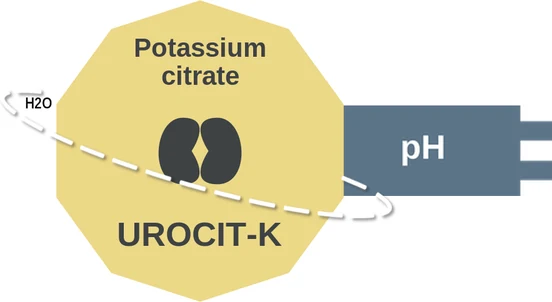
Potassium citrate
UROCIT-K
What it isPotassium salt that alkalinizes urine and complexes calcium; hypocitraturic calcium stones and uric-acid stones.
Why this oneUnlike sodium alkali, it supplies citrate without a sodium load and can also correct hypokalemia.
What limits itHyperkalemia limits use in kidney disease or with RAAS blockers; monitor potassium and avoid when GI transit is impaired.
FDA label
Read the full label on DailyMed ↗
| FDA dosing | Population | Start | Target | Max |
|---|---|---|---|---|
| Severe hypocitraturia (urinary citrate <150 mg/day) | Adults | 60 mEq/day: 30 mEq BID or 20 mEq TID, with/within 30 min after meals or bedtime snack | Urinary citrate >320 mg/day (goal ~640), urine pH 6.0-7.0 | 100 mEq/day |
| Mild-moderate hypocitraturia (urinary citrate >150 mg/day) | Adults | 30 mEq/day: 15 mEq BID or 10 mEq TID, with/within 30 min after meals or bedtime snack | Urinary citrate >320 mg/day (goal ~640), urine pH 6.0-7.0 | 100 mEq/day |
Renal Contraindicated if GFR <0.7 mL/kg/min (soft-tissue calcification, hyperkalemia); avoid in chronic renal failure
Hepatic Undefined
Doses >100 mEq/day not studied — avoid
Instructions
- Take with meals or within 30 min after meals or a bedtime snack
- Add to a regimen limiting salt intake with high fluid intake (urine volume ≥2 L/day)
- Adjust dose by 24-h urinary citrate and/or pH; recheck every 4 months
- Monitor serum electrolytes, creatinine, and CBC every 4 months (more often if cardiac/renal disease or acidosis); periodic ECGs
- Discontinue if hyperkalemia, significant creatinine rise, or significant fall in Hct/Hgb
- Intact wax matrices may appear in stool (expected)
Contraindications
- Hyperkalemia or conditions predisposing to it (chronic renal failure, uncontrolled diabetes, acute dehydration, strenuous exercise in unconditioned individuals, adrenal insufficiency, extensive tissue breakdown, potassium-sparing agents) — risk of cardiac arrest
- Arrest/delay of tablet passage through the GI tract: delayed gastric emptying, esophageal compression, intestinal obstruction or stricture, or anticholinergic use
- Peptic ulcer disease (ulcerogenic potential)
- Active urinary tract infection (bacterial citrate degradation attenuates effect; higher pH may promote bacterial growth)
- Renal insufficiency (GFR <0.7 mL/kg/min)
Cautions
- Hyperkalemia and cardiac arrest in patients with impaired potassium excretion — can develop rapidly and be asymptomatic; avoid in chronic renal failure, severe myocardial damage, or heart failure; monitor with periodic blood tests and ECGs
- GI lesions — solid potassium dosage forms have caused stenotic/ulcerative small-bowel lesions, upper GI bleeding, and deaths (~1 per 100,000 patient-years); stop immediately and investigate perforation/obstruction if severe vomiting, abdominal pain, or GI bleeding
Adverse reactions
- Abdominal discomfort
- Vomiting
- Diarrhea/loose stools
- Nausea
- GI symptoms lessen when taken with meals/snacks or by dose reduction
Pregnancy Animal reproduction studies not conducted; give only if clearly needed
Lactation Human milk potassium is ~13 mEq/L; effect of Urocit-K unknown — use only if clearly needed
NO BOXED WARNINGS
Classes and tags
Clinical profile
Mechanism of action: Potassium citrate ballicule