Potassium chloride
KLOR-CON
What it isPotassium salt that restores depleted potassium; treatment and prevention of hypokalemia.
Why this oneIt replaces both potassium and chloride, making it the default salt for diuretic- or GI-loss hypokalemia.
What limits it⚑ Never give concentrated IV potassium undiluted. Oral solid forms can ulcerate the GI tract; renal impairment raises hyperkalemia risk.
FDA-approved for
- treatment and prevention of hypokalemia
FDA label
Read the full label on DailyMed ↗
| FDA dosing | Population | Start | Target | Max |
|---|---|---|---|---|
| Treatment of hypokalemia | Adults | 40-100 mEq/day in divided doses | 40 mEq per single dose | |
| Prevention of hypokalemia | Adults | 20 mEq/day |
Renal Reduced potassium excretion — start at low end of range; increased hyperkalemia risk (esp. with RAAS inhibitors/NSAIDs); monitor serum potassium frequently
Hepatic Cirrhosis: start at low end of dosing range and monitor serum potassium frequently
No more than 40 mEq per single dose; divide daily doses >40 mEq
Instructions
- Take with meals and a full glass of water or other liquid; not on an empty stomach
- Swallow tablets whole — do not crush, chew, or suck
- If serum potassium <2.5 mEq/L, use IV potassium instead of oral supplementation
- Do not give more than 40 mEq in a single dose
Contraindications
- Concomitant use with triamterene or amiloride (potassium-sparing diuretics)
Cautions
- GI irritation with ulcerative/stenotic lesions — take with meals, consider liquid form in dysphagia/GI motility disorders
- Hyperkalemia, especially in renal impairment
- Discontinue if severe vomiting, abdominal pain, distention, or GI bleeding occurs
Adverse reactions
- Nausea
- Vomiting
- Flatulence
- Abdominal pain/discomfort
- Diarrhea
- Hyperkalemia
Pregnancy No human data; potassium supplementation not leading to hyperkalemia is not expected to cause fetal harm.
Lactation Supplementation has little or no effect on milk potassium levels (normal milk ~13 mEq/L).
NO BOXED WARNINGS
Principal riskUndiluted intravenous potassium is fatal
Cost, est. cash$10–$500/bag or supply
Generic entryLong generic
Classes and tags
Clinical profile
Legacy pregnancy categoryUnknown / historical label unavailable
Defining liabilityUsually well tolerated at replacement doses; excessive dosing can cause agent-specific metabolic or organ toxicity.
Mechanism of action: Potassium chloride ballicule
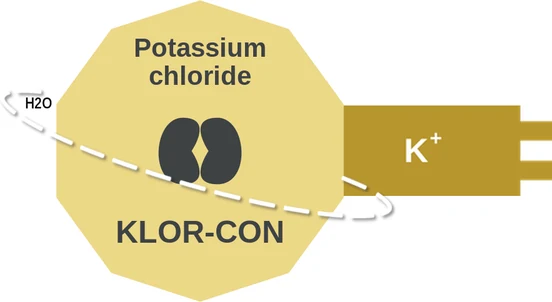
Open Potassium chloride in the interactive console ↗
Memory aids: mascots and interaction avatars
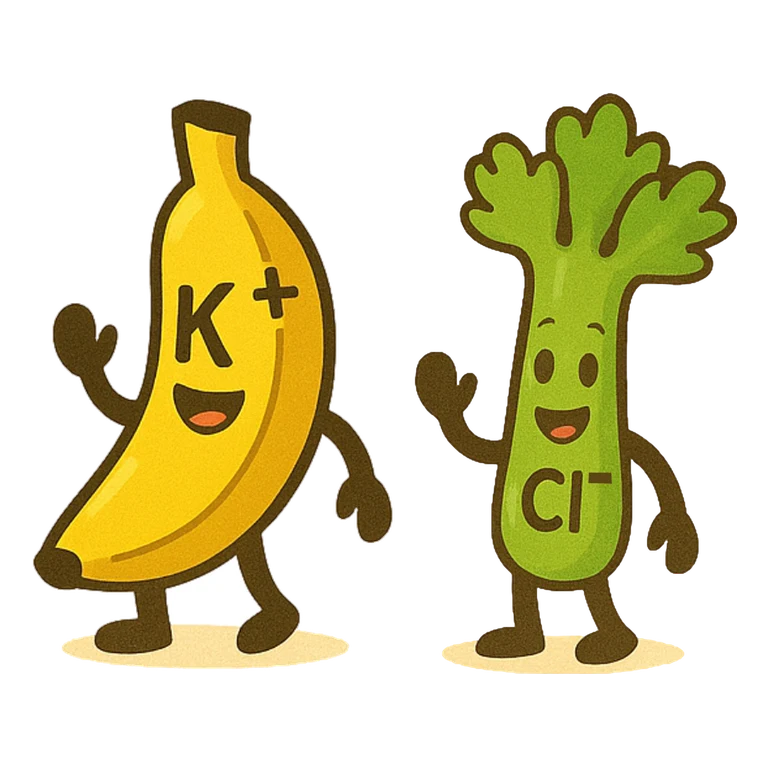
Bananas are well-known for containing potassium
Celery has a high chloride to sodium ratio and C.L. is a CeLery sound-alike