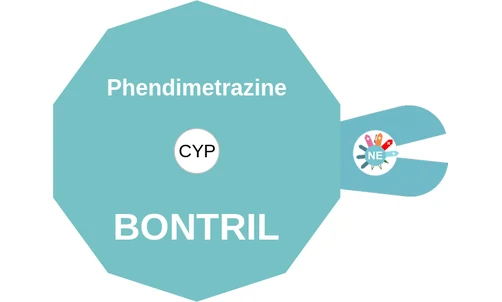
Phendimetrazine
BONTRIL
What it isNorepinephrine-releasing sympathomimetic and prodrug of phenmetrazine; brief adjunct for weight management.
Why this oneConversion to phenmetrazine brings substantial stimulant and abuse liability with little role beyond short-term appetite suppression.
What limits itBlood pressure and heart rate rise; avoid cardiovascular disease and MAOIs. Tolerance and dependence limit use.
FDA label
Read the full label on DailyMed ↗
| FDA dosing | Population | Start | Target | Max |
|---|---|---|---|---|
| Obesity (anorectic; indication inferred from Clinical Pharmacology — Indications section not in source data) | Adults | 35 mg (1 tab) BID–TID, 1 h before meals; 17.5 mg (½ tab) per dose may be adequate | Lowest effective dose, BID–TID | 70 mg TID (2 tabs TID) |
Renal Undefined
Hepatic Undefined
Instructions
- Take 1 hour before meals
- Individualize to lowest effective dosage
Contraindications
- Known hypersensitivity or idiosyncratic reactions to sympathomimetics
- Advanced arteriosclerosis, symptomatic cardiovascular disease, moderate-severe hypertension, hyperthyroidism, glaucoma
- Highly nervous or agitated patients
- History of drug abuse
- Concurrent other CNS stimulants, including MAOIs
Adverse reactions
- CV: palpitations, tachycardia, elevated BP, ischemic events; valvular heart disease reported with some anorectics (fenfluramine/dexfenfluramine, esp. in combination) — no cases reported with phendimetrazine alone
- CNS: overstimulation, restlessness, insomnia, agitation, flushing, tremor, sweating, dizziness, headache, psychotic state, blurred vision
- GI: dry mouth, nausea, diarrhea, constipation, stomach pain
- GU: urinary frequency, dysuria, changes in libido
Pregnancy Undefined
Lactation Undefined
NO BOXED WARNINGS
Principal riskBlood pressure and heart rate rise; short-term use only
Classes and tags
Clinical profile
Mechanism of action: Phendimetrazine ballicule