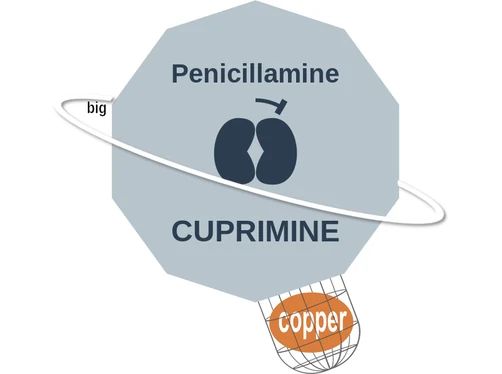
Penicillamine
CUPRIMINE
What it isChelator of copper and heavy metals; Wilson disease, cystinuria and lead poisoning.
Why this oneIt is the long-established oral treatment for Wilson disease and reduces cystine stone formation.
What limits itParadoxical neurological worsening early in Wilson disease. Myelosuppression, proteinuria and drug-induced autoimmunity; pyridoxine is co-given.
FDA label
Read the full label on DailyMed ↗
| FDA dosing | Population | Start | Target | Max |
|---|---|---|---|---|
| Wilson's disease | adult | 250 mg QD (if intolerant) up to 750 mg-1.5 g/day | 0.75-1.5 g/day | 2 g/day |
| Cystinuria | adult | 250 mg QD, increase gradually | 2 g/day QID | 4 g/day |
| Cystinuria | pediatric | 30 mg/kg/day divided QID | ||
| Rheumatoid arthritis | adult | 125-250 mg QD | 500-750 mg/day | ~1.5 g/day |
Titration RA: increase by 125-250 mg/day at 1-3 month intervals.
Renal Undefined
Hepatic Undefined
Doses <=500 mg/day may be given once daily; >500 mg/day must be divided.
Instructions
- Take on empty stomach, >=1 h before or 2 h after meals, and >=1 h apart from any other drug, food, or milk
- Supplement pyridoxine (increased requirement)
- Cystinuria: drink copiously incl. ~1 pint at bedtime and once overnight; retain bedtime dose if reducing
- After interrupted therapy, reintroduce cautiously at a lower dose
Contraindications
- Pregnancy (except Wilson's disease or certain cystinuria patients)
- Nursing mothers should not breastfeed during therapy
- Prior penicillamine-related aplastic anemia or agranulocytosis (do not restart)
- Rheumatoid arthritis patients with history/evidence of renal insufficiency
Cautions
- Bone marrow depression - aplastic anemia, agranulocytosis, thrombocytopenia, leukopenia (fatalities reported)
- Proteinuria/hematuria progressing to nephrotic syndrome (immune complex glomerulopathy)
- Autoimmune syndromes: pemphigus, myasthenia gravis, Goodpasture's, drug-induced lupus, polymyositis
- Increased pyridoxine requirement
Adverse reactions
- GI upset - anorexia, nausea, vomiting, diarrhea (17%)
- Taste blunting/loss (12%)
- Proteinuria (6%)
- Rash, generalized pruritus (5%)
- Thrombocytopenia (4%)
- Leukopenia (2%)
Pregnancy Pregnancy Category D.
Lactation Do not nurse during penicillamine therapy.
⚠ BOXED WARNING
- Toxicity requires close supervision by an experienced physician
Cost, est. cash$10–$500/month
Generic entry2019
Classes and tags
Clinical profile
Legacy pregnancy categoryC
Defining liabilitySerious infection, cytopenias, hepatic injury and malignancy risk require laboratory and clinical monitoring.
Mechanism of action: Penicillamine ballicule