Nalmefene
opioid antag.
What it isLong-acting opioid receptor antagonist used intranasally for emergency reversal of known or suspected opioid overdose.
Why this oneIts duration is longer than naloxone’s and may better match long-acting or high-potency synthetic opioids.
What limits itIt can precipitate severe, prolonged withdrawal and does not replace ventilation, repeat dosing, surveillance, or emergency care.
FDA-approved for
- opioid overdose (1995)
- alcohol use disorder (EU)
FDA label
Read the full label on DailyMed ↗
| FDA dosing | Population | Start | Target | Max |
|---|---|---|---|---|
| Opioid overdose (emergency reversal) | Adults & peds ≥12 yr | 1.5 mg IM/SC | 1.5 mg IM/SC | repeat q2–5 min PRN (new auto-injector each dose) |
Renal No adjustment needed for single episodes of opioid antagonism (clearance reduced in impairment)
Hepatic No adjustment needed for single episodes of opioid antagonism (clearance reduced in impairment)
Repeat every 2–5 min with a new auto-injector until emergency help arrives
Instructions
- IM/SC into anterolateral (outer) thigh only, through clothing if needed
- Single-use auto-injector; do not prime or reuse
- Seek emergency medical care immediately after first dose
- Re-administer with a new auto-injector every 2–5 min if no response or relapse into respiratory depression
Cautions
- Recurrent respiratory/CNS depression — keep under surveillance
- Limited efficacy vs partial/mixed opioid agonists (e.g., buprenorphine); repeat doses may be needed
- May precipitate severe opioid withdrawal (life-threatening in neonates)
- Abrupt reversal may cause adverse cardiovascular effects (esp. preexisting CV disease)
- Attempts to overcome the blockade with opioids can cause intoxication and death
Adverse reactions
- Feeling hot
- Nausea
- Headache
- Dizziness
- Chills
- Vomiting
- Allodynia
- Palpitations
- Tinnitus
Pregnancy No human data; do not withhold for opioid overdose; no embryo-fetal harm in animals
Lactation No human data; present in rat milk
NO BOXED WARNINGS
Principal risksevere, prolonged precipitated opioid withdrawal
Cost, est. cash$75–$200/2-dose kit
Generic entryBy 2023
Classes and tags
Clinical profile
Legacy pregnancy categoryC
Defining liabilityUsually well tolerated; abrupt opioid withdrawal can be severe and prolonged.
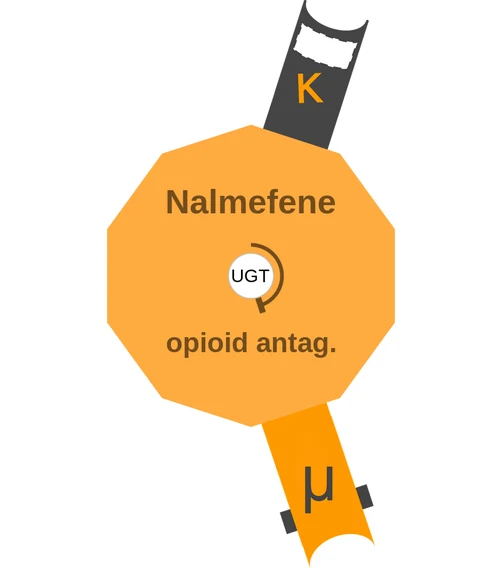
Mechanism of action: Nalmefene ballicule
Open Nalmefene in the interactive console ↗
Memory aids: mascots and interaction avatars