Mifepristone
KORLYM
Pronunciation: mi-FE-pri-stoen (KOR-lim)
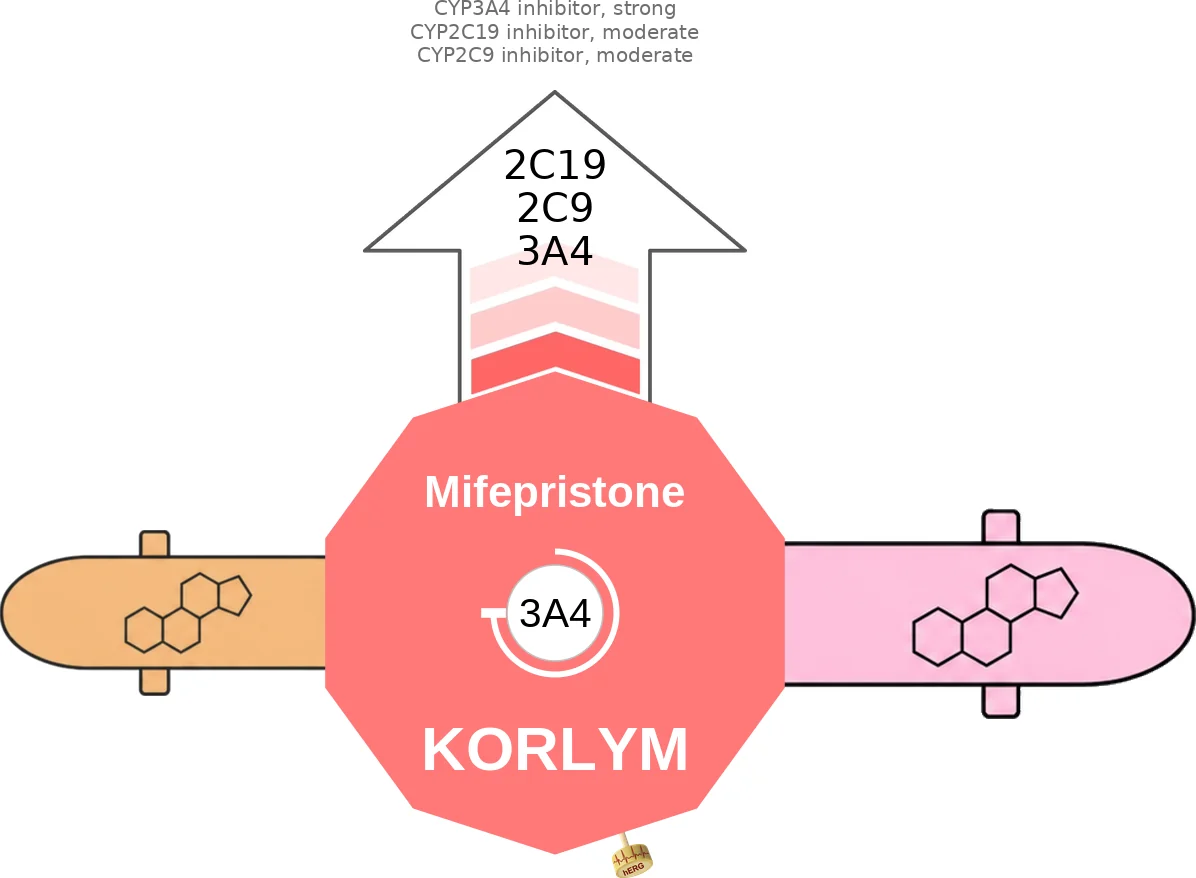
What it isProgesterone- and glucocorticoid-receptor antagonist; pregnancy termination and Cushing-syndrome hyperglycemia.
Why this oneThe same receptor pharmacology enables medical abortion with misoprostol and cortisol blockade without lowering cortisol levels.
What limits itAbortion use can cause severe bleeding or infection; Cushing treatment can cause adrenal insufficiency, hypokalemia, and QT prolongation.
FDA-approved for
- pregnancy termination (2000)
- Cushing hyperglycemia (2012)
Classes and tags
Clinical profile
Legacy pregnancy categoryX
Defining liabilityGenerally tolerated at therapeutic doses; clinically important risks are agent-specific and increase with interactions or organ impairment.
FDA label
Read the full label on DailyMed ↗
| FDA dosing | Population | Start | Target | Max |
|---|---|---|---|---|
| Hyperglycemia secondary to hypercortisolism in endogenous Cushing's syndrome with type 2 diabetes or glucose intolerance, after failed surgery or not a surgical candidate | Adults | 300 mg PO QD with a meal | Increase in 300 mg increments per clinical response and tolerability | 1200 mg QD; not to exceed 20 mg/kg per day |
| Same — renal impairment | Adults, renal impairment | 300 mg QD (no change in initial dose) | Titrate in 300 mg increments | 600 mg QD |
| Same — mild to moderate hepatic impairment | Adults, mild–moderate hepatic impairment | 300 mg QD (no change in initial dose) | Titrate in 300 mg increments | 600 mg QD; do not use in severe hepatic impairment |
| Same — already on a strong CYP3A inhibitor | Adults on strong CYP3A inhibitors | 300 mg QD | Titrate only if clinically indicated | 900 mg QD |
Titration Increase no more frequently than once every 2-4 weeks.
Renal No change in initial dose; maximum 600 mg QD.
Hepatic Mild to moderate: no change in initial dose; maximum 600 mg QD. Severe: do not use.
Serum cortisol stays elevated on KORLYM and cannot be used to assess adrenal insufficiency.
Instructions
- Negative pregnancy test (females of reproductive potential) before starting and if treatment is interrupted for more than 14 days.
- Single daily dose, always with a meal; swallow whole — do not split, crush, or chew.
- Adding a strong CYP3A inhibitor to current KORLYM: 300 mg no change; 600 mg → 300 mg (max 600 mg); 900 mg → 600 mg (max 900 mg); 1200 mg → 900 mg.
- After an interruption, restart at the lowest dose (300 mg); after interruption for adverse reactions, aim for a dose lower than the one that caused it.
- Correct hypokalemia before starting; check potassium 1 to 2 weeks after starting or increasing the dose and periodically thereafter.
- Wait at least 2 weeks after stopping KORLYM before starting or increasing an interacting drug.
- Use non-hormonal contraception (KORLYM interferes with hormonal contraceptives).
Available strengths
- tab 200, 300 mg
Contraindications
- Pregnancy
- Concomitant CYP3A substrates: simvastatin, lovastatin, and narrow-therapeutic-range CYP3A substrates (cyclosporine, dihydroergotamine, ergotamine, fentanyl, pimozide, quinidine, sirolimus, tacrolimus)
- Systemic corticosteroids for lifesaving purposes (e.g., immunosuppression after organ transplantation)
- History of unexplained vaginal bleeding, endometrial hyperplasia with atypia, or endometrial carcinoma
Cautions
- Adrenal insufficiency — monitor clinically (cortisol not reliable); stop and give glucocorticoids if suspected
- Hypokalemia — correct before, monitor during
- Vaginal bleeding and endometrial changes; caution with hemorrhagic disorders/anticoagulants
- QT interval prolongation
- Exacerbation of conditions treated with corticosteroids
- Strong CYP3A inhibitors — use only when necessary, cap dose
- Pneumocystis jiroveci infection
- Potential effects of hypercortisolemia (heart failure, coronary disease)
Adverse reactions
- Nausea (48%)
- Fatigue (48%)
- Headache (44%)
- Endometrial hypertrophy (38%)
- Blood potassium decreased (34%)
- Arthralgia (30%)
- Vomiting (26%)
- Peripheral edema (26%)
- Hypertension (24%)
- Dizziness (22%)
- Decreased appetite (20%)
Pregnancy Contraindicated — causes pregnancy loss; single-dose human data showed a higher rate of major birth defects; exclude pregnancy and use non-hormonal contraception.
Lactation Present in human milk (amount with long-term use unknown); weigh benefits; may pump and discard during treatment and for 18-21 days after the last dose.
Cost
| Strength | #/mo | generic $/unit | CostPlus | |
|---|---|---|---|---|
| 200 mg | tab | per unit | not offered | |
| 300 mg | tab | per unit | not offered |
Generic entry2019
Open Mifepristone in the interactive console ↗
Self-check
- Does mifepristone’s cortisol blockade lower cortisol levels?
No. - Which companion drug is used with mifepristone for medical abortion?
Misoprostol.