Metoclopramide
REGLAN
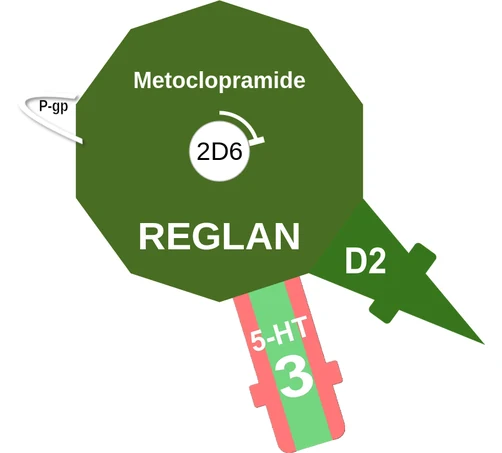
What it isD2 and 5-HT3 antagonist; prokinetic for gastroparesis and GERD, and an antiemetic adjunct in migraine.
Why this oneIt combines antiemetic action with accelerated gastric emptying, which ondansetron does not.
What limits itTardive dyskinesia risk rises with duration. Acute dystonia is prominent in younger patients; avoid in bowel obstruction.
FDA-approved for
- gastroparesis/GERD (~1979)
Off-label
- migraine (adjunct)
- lactation
FDA label
Read the full label on DailyMed ↗
| FDA dosing | Population | Start | Target | Max |
|---|---|---|---|---|
| Symptomatic documented GERD (failed conventional therapy) | Adult | 10–15 mg QID (30 min before meals + bedtime); or up to 20 mg PRN before provoking situation | 60 mg/day; ≤12 weeks | |
| Acute/recurrent diabetic gastroparesis | Adult | 10 mg QID (30 min before meals + bedtime) | 40 mg/day; avoid >12 weeks |
Renal CrCl ≤60 mL/min (incl. ESRD/dialysis): reduce dosage
Hepatic Child-Pugh B or C: reduce dosage; Child-Pugh A: no adjustment
Instructions
- Administer 30 minutes before each meal and at bedtime
- Use shortest duration; reassess need; max 12 weeks
- CYP2D6 poor metabolizers or strong CYP2D6 inhibitors: reduce dosage
- Elderly: start 5 mg QID and titrate
Contraindications
- History of tardive dyskinesia or dystonic reaction to metoclopramide
- When GI motility stimulation is dangerous (GI hemorrhage, mechanical obstruction, perforation)
- Pheochromocytoma or catecholamine-releasing paragangliomas
- Epilepsy
Cautions
- Tardive dyskinesia, other EPS/parkinsonism/akathisia
- Neuroleptic malignant syndrome
- Depression and suicidal ideation
- MAOIs due to risk of serotonin syndrome
- Fluid retention/volume overload in cirrhosis or CHF
- Hyperprolactinemia
- Impairs ability to drive/operate machinery
Adverse reactions
- Restlessness
- Drowsiness
- Fatigue and lassitude
- Extrapyramidal symptoms / acute dystonia
- Insomnia, headache, dizziness
- Depression
Pregnancy Studies do not report increased risk of adverse pregnancy outcomes; monitor neonate for EPS and methemoglobinemia if given at delivery
Lactation Present in human milk in variable amounts; monitor infant for GI effects, EPS, methemoglobinemia
⚠ BOXED WARNING
- Tardive dyskinesia
Cost, est. cash$20–$1,500/dose or month
Generic entry1985
Classes and tags
Clinical profile
Legacy pregnancy categoryB
Defining liabilityGenerally tolerated at therapeutic doses; clinically important risks are agent-specific and increase with interactions or organ impairment.
Mechanism of action: Metoclopramide ballicule
Open Metoclopramide in the interactive console ↗
Memory aids: mascots and interaction avatars

Rainbow spray → antiemetic