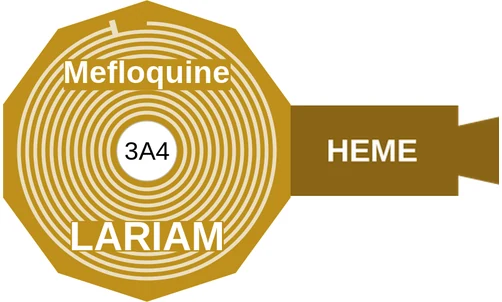
Mefloquine
LARIAM
What it isAntimalarial impairing parasite heme detoxification; malaria treatment and prophylaxis.
Why this oneIts long action permits weekly prophylaxis and retains value where chloroquine resistance is widespread.
What limits itVivid dreams, anxiety, psychosis, and other neuropsychiatric effects can persist after stopping; avoid in psychiatric or seizure history.
FDA-approved for
- malaria treatment and prophylaxis
FDA label
Read the full label on DailyMed ↗
| FDA dosing | Population | Start | Target | Max |
|---|---|---|---|---|
| Malaria treatment (mild-moderate, P. falciparum or P. vivax) | Adult | 1250 mg (5 tab) as a single oral dose | single dose | |
| Malaria prophylaxis | Adult | 250 mg once weekly | 250 mg weekly | |
| Malaria treatment (P. falciparum) | Peds ≥6 mo | 20–25 mg/kg (may split into 2 doses 6–8 h apart); not to exceed adult dose | 1250 mg | |
| Malaria prophylaxis | Pediatric | ~5 mg/kg once weekly (weight-based tablet fractions; 250 mg if >45 kg) | 250 mg weekly |
Renal Undefined
Hepatic Undefined
If no improvement within 48–72 h, do not retreat with mefloquine; after P. vivax, follow with an 8-aminoquinoline (e.g., primaquine) to prevent relapse.
Instructions
- Do not take on an empty stomach; take with at least 8 oz (240 mL) water.
- Prophylaxis: begin 1 week before travel, take same day each week (preferably after main meal), continue 4 weeks after leaving the endemic area.
- Tablets may be crushed and suspended in liquid for children unable to swallow whole.
- If vomiting occurs <30 min after a treatment dose, repeat full dose; if 30–60 min, give an additional half-dose.
Contraindications
- Hypersensitivity to mefloquine or related compounds (quinine, quinidine).
- Prophylaxis in patients with active/recent depression, generalized anxiety disorder, psychosis, schizophrenia, other major psychiatric disorders, or a history of convulsions.
Cautions
- Neuropsychiatric reactions (anxiety, depression, hallucinations, psychosis) that may persist after stopping.
- Dizziness, vertigo, tinnitus, loss of balance — may be prolonged or permanent.
- Cardiac conduction disturbances.
- Seizures; hepatic disorders; ophthalmologic effects.
Adverse reactions
- Treatment: dizziness, myalgia, nausea, fever, headache, vomiting, chills, diarrhea, rash, abdominal pain, fatigue, loss of appetite, tinnitus
- Prophylaxis: vomiting, dizziness, neuropsychiatric events (headache, somnolence, sleep disorders)
Pregnancy Undefined
Lactation Undefined
⚠ BOXED WARNING
- Neuropsychiatric adverse reactions that may persist after discontinuation
Cost, est. cash$10–$300/month
Generic entry2002
Classes and tags
Clinical profile
Legacy pregnancy categoryUnknown / historical label unavailable
Defining liabilityGenerally tolerated at therapeutic doses; clinically important risks are agent-specific and increase with interactions or organ impairment.
Mechanism of action: Mefloquine ballicule